The Sun
The Sun is a yellow dwarf star (G2V), about 4.6 billion years old, and the dominant gravitational force in the Solar System. It has a diameter of roughly 1.4 million kilometers and contains around 99.8% of the Solar System’s mass. Nuclear fusion in its core converts hydrogen into helium, producing energy that warms the planets. Above the core lie the radiative and convective zones, followed by the visible photosphere (~5,500 °C), the chromosphere, and the much hotter corona (~2 million °C).
Source: science.nasa.gov
APODs including "The Sun"
Sunset: Planet Earth
20/03/2008
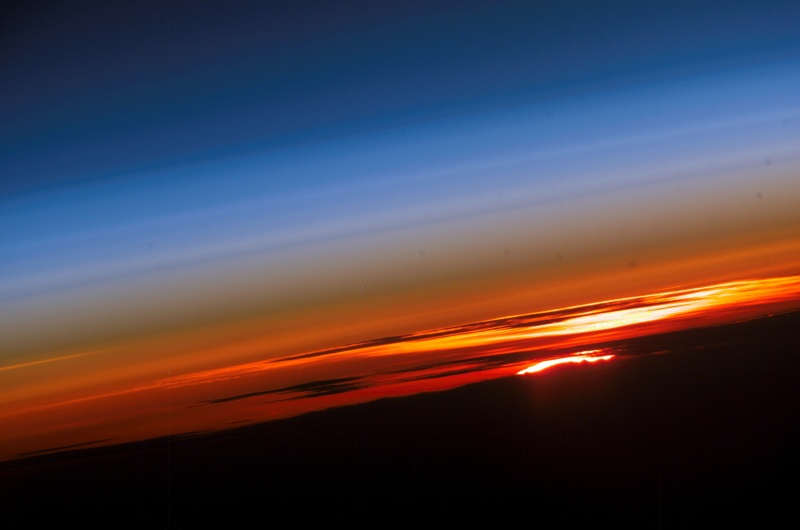
Today, the Sun crosses the celestial equator heading north at 0548 UT. Known as the equinox, the geocentric astronomical event marks the first day of spring in the northern hemisphere and autumn in the south. Equinox means equal night and with the Sun on the celestial equator, Earth dwellers will experience nearly 12 hours of daylight and 12 hours of darkness. Of course, for those in the north, the days will grow longer with the Sun marching higher in the sky as summer approaches. To celebrate the equinox, consider this colorful view of the setting Sun. Recorded last June from the International Space Station, the Sun's limb still peeks above the distant horizon as seen from Earth orbit. Clouds appear in silhouette as the sunlight is reddened by dust in the dense lower atmosphere. Molecules in the more tenuous upper atmosphere are preferentially scattering blue light.