The Sun
The Sun is a yellow dwarf star (G2V), about 4.6 billion years old, and the dominant gravitational force in the Solar System. It has a diameter of roughly 1.4 million kilometers and contains around 99.8% of the Solar System’s mass. Nuclear fusion in its core converts hydrogen into helium, producing energy that warms the planets. Above the core lie the radiative and convective zones, followed by the visible photosphere (~5,500 °C), the chromosphere, and the much hotter corona (~2 million °C).
Source: science.nasa.gov
APODs including "The Sun"
Two-Armed Spiral Milky Way
06/06/2008
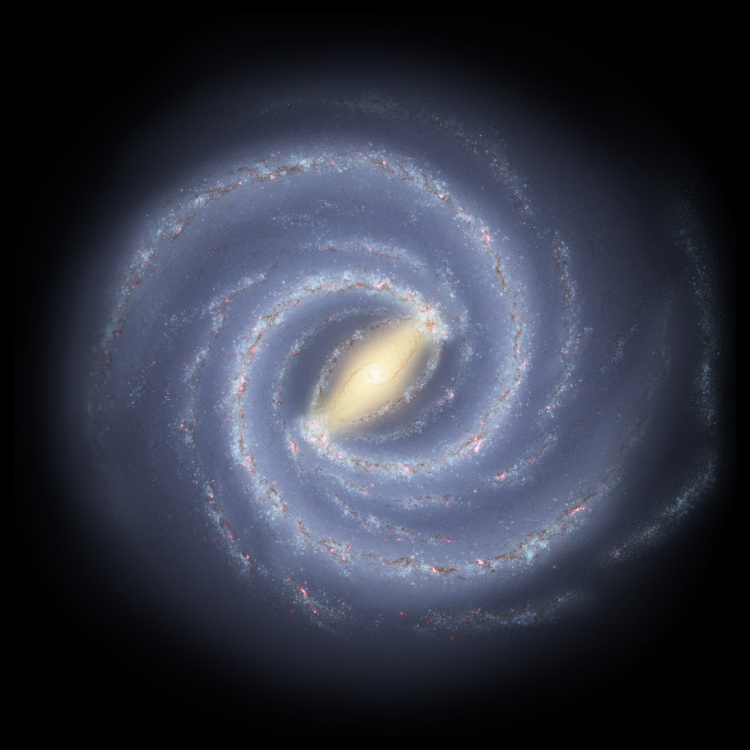
Gazing out from within the Milky Way, our own galaxy's true structure is difficult to discern. But an ambitious survey effort with the Spitzer Space Telescope now offers convincing evidence that we live in a large galaxy distinguished by two main spiral arms (the Scutum-Centaurus and Perseus arms) emerging from the ends of a large central bar. In fact, from a vantage point that viewed our galaxy face-on, astronomers in distant galaxies would likely see the Milky Way as a two-armed barred spiral similar to this artist's illustration. Previous investigations have identified a smaller central barred structure and four spiral arms. Astronomers still place the Sun about a third of the way in from the Milky Way's outer edge, in a minor arm called the Orion Spur. To locate the Sun and identify the Milky Way's newly mapped features, just place your cursor over the image.