The Sun
The Sun is a yellow dwarf star (G2V), about 4.6 billion years old, and the dominant gravitational force in the Solar System. It has a diameter of roughly 1.4 million kilometers and contains around 99.8% of the Solar System’s mass. Nuclear fusion in its core converts hydrogen into helium, producing energy that warms the planets. Above the core lie the radiative and convective zones, followed by the visible photosphere (~5,500 °C), the chromosphere, and the much hotter corona (~2 million °C).
Source: science.nasa.gov
APODs including "The Sun"
A Total Solar Eclipse Over China
05/08/2008
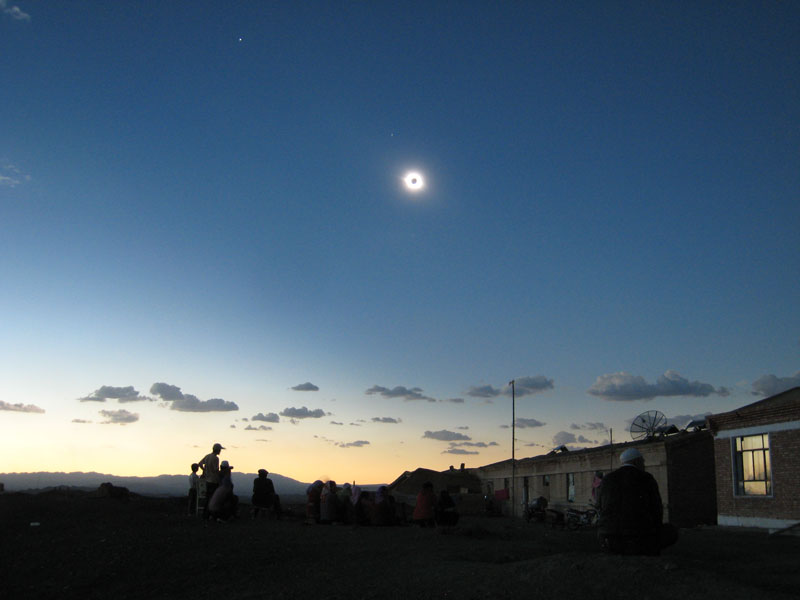
What's that black dot over the Sun? The Moon. This past weekend, the Sun went dark during the day as the Moon completely covered it. The total solar eclipse was visible over a thin swath of Earth extending from northern Canada to China. As shown above, many sky enthusiasts gathered to witness the total or partial solar eclipse, which lasted only a few minutes. The above image was taken during totality near Barkol in Xinjiang, China, with the Barkol Shan mountain range visible on the horizon. Although the brightest parts of the Sun are covered, the normally invisible corona of hot gas surrounding the Sun became prominent. Just to the upper left of the Moon darkened Sun are planets Mercury and Venus. The increased darkening of the sky toward the right indicates the darkened atmosphere created by the passing shadow cone of the total solar eclipse. The next total solar eclipse will occur next July and be visible in parts of India and China.