The Sun
The Sun is a yellow dwarf star (G2V), about 4.6 billion years old, and the dominant gravitational force in the Solar System. It has a diameter of roughly 1.4 million kilometers and contains around 99.8% of the Solar System’s mass. Nuclear fusion in its core converts hydrogen into helium, producing energy that warms the planets. Above the core lie the radiative and convective zones, followed by the visible photosphere (~5,500 °C), the chromosphere, and the much hotter corona (~2 million °C).
Source: science.nasa.gov
APODs including "The Sun"
Planets over Perth
12/09/2008
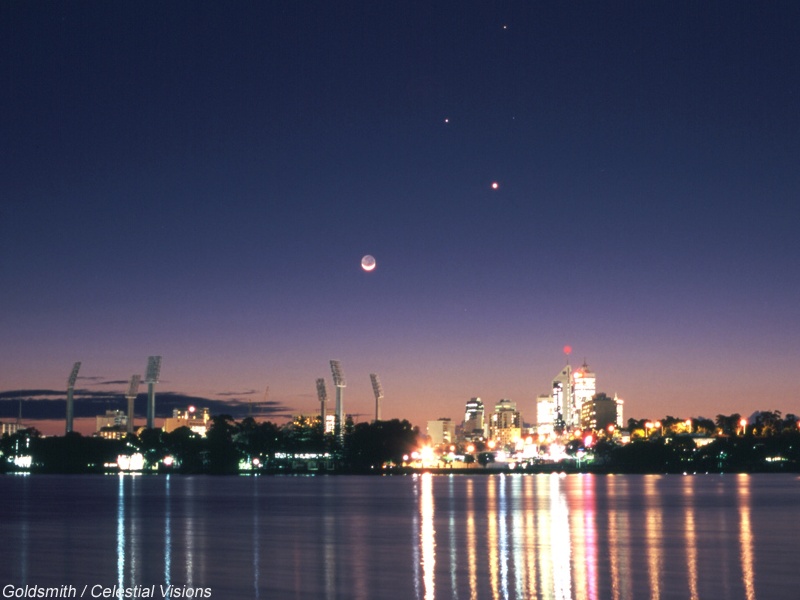
A bright trio of terrestrial planets was joined by a young Moon on September 1st, in planet Earth's early evening skies. In this view of the celestial gathering from Perth, Western Australia, the Moon's sunlit crescent is nearly horizontal at Perth's southern latitude of about 32 degrees. Venus, then Mercury, and finally Mars shine above colorful city lights on the far shore of the Swan River. The six unlit towers on the left surround a large cricket stadium. For now, the planetary trio still lingers low in the west just after sunset. But in the coming days Venus will move farther from the Sun, climbing higher after sunset, while Mercury and Mars will steadily sink into the glare along the western horizon. Note: Free Astronomy Course Taught Online by an APOD Editor