The Sun
The Sun is a yellow dwarf star (G2V), about 4.6 billion years old, and the dominant gravitational force in the Solar System. It has a diameter of roughly 1.4 million kilometers and contains around 99.8% of the Solar System’s mass. Nuclear fusion in its core converts hydrogen into helium, producing energy that warms the planets. Above the core lie the radiative and convective zones, followed by the visible photosphere (~5,500 °C), the chromosphere, and the much hotter corona (~2 million °C).
Source: science.nasa.gov
APODs including "The Sun"
A Darkened Sky
20/09/2008
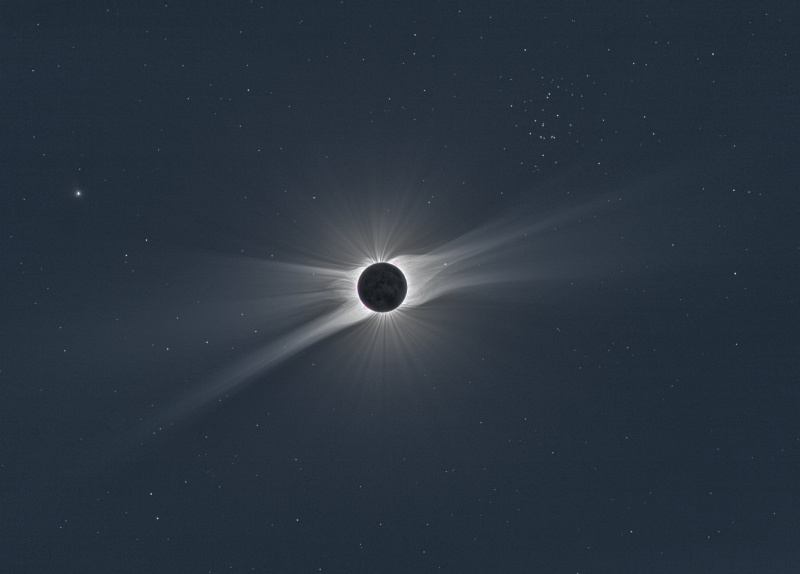
For a moment on August 1st, the daytime sky grew dark along the path of a total solar eclipse. While watching the geocentric celestial event from Mongolia, photographer Miloslav Druckmuller recorded multiple images with two separate cameras as the Moon blocked the bright solar disk and darkened the sky. This final composition consists of 55 frames ranging in exposure time from 1/125 to 8 seconds. It spans nearly 12 degrees, with the relative position of the Moon and Sun corresponding to mid-eclipse. On the left is bright planet Mercury, but many stars are also visible, including the Praesepe star cluster (also known as M44 or the Beehive cluster) in Cancer, above and to the right of the silhouetted Moon. Remarkably, the nearly perfect conditions and wide range in individual exposures allow the composite picture to register the lunar surface and follow the delicate solar corona out to a distance of nearly 20 times the radius of the Sun. In fact, the composite presents a range in brightness beyond what the eye could see during the eclipse.