The Sun
The Sun is a yellow dwarf star (G2V), about 4.6 billion years old, and the dominant gravitational force in the Solar System. It has a diameter of roughly 1.4 million kilometers and contains around 99.8% of the Solar System’s mass. Nuclear fusion in its core converts hydrogen into helium, producing energy that warms the planets. Above the core lie the radiative and convective zones, followed by the visible photosphere (~5,500 °C), the chromosphere, and the much hotter corona (~2 million °C).
Source: science.nasa.gov
APODs including "The Sun"
Two Tails of Comet Lulin
25/02/2009
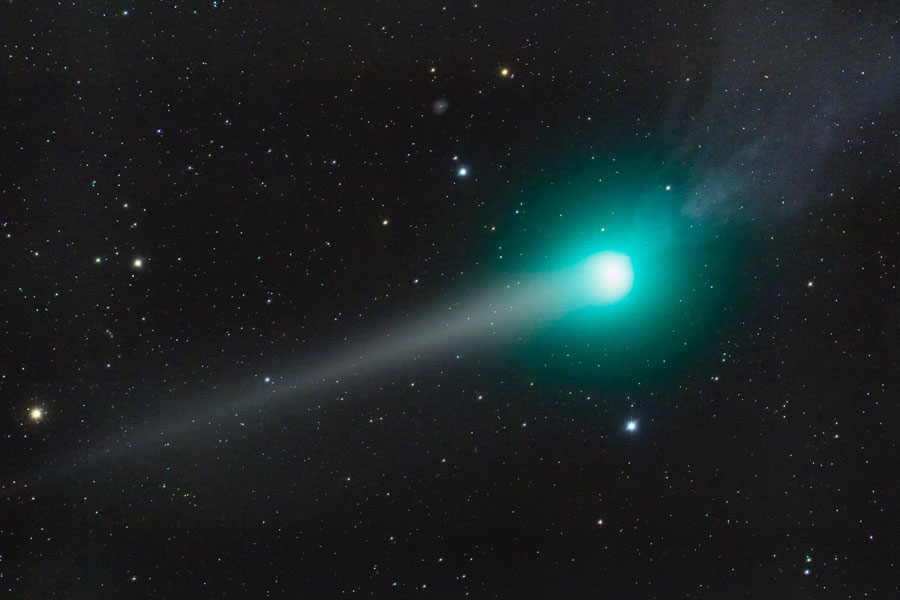
Go outside tonight and see Comet Lulin. From a dark location, you should need only a good star map and admirable perseverance -- although wide-field binoculars might help. Yesterday, Comet Lulin passed its closest to Earth, so that the comet will remain near its brightest over the next few days. The comet is currently almost 180 degrees around from the Sun and so visible nearly all night long, but will appear to move on the sky about 10 full moons a night. In this image, Comet Lulin was captured in spectacular form two nights ago from New Mexico, USA. The central coma of the comet is appearing quite green, a color likely indicating glowing molecular carbon gasses. Bright stars and a distant spiral galaxy are clearly visible in the image background. The yellow dust tail, reflecting sunlight, is visible sprawling to the coma's left trailing behind the comet, while the textured bluish-glowing ion tail is visible to the coma's right, pointing away from the Sun. Over the past few weeks, from the current vantage point of Earth, these two tails appeared to point in opposite directions. Comet Lulin is expected to slowly fade over the next few weeks.