The Sun
The Sun is a yellow dwarf star (G2V), about 4.6 billion years old, and the dominant gravitational force in the Solar System. It has a diameter of roughly 1.4 million kilometers and contains around 99.8% of the Solar System’s mass. Nuclear fusion in its core converts hydrogen into helium, producing energy that warms the planets. Above the core lie the radiative and convective zones, followed by the visible photosphere (~5,500 °C), the chromosphere, and the much hotter corona (~2 million °C).
Source: science.nasa.gov
APODs including "The Sun"
Lulin and Saturn near Opposition
27/02/2009
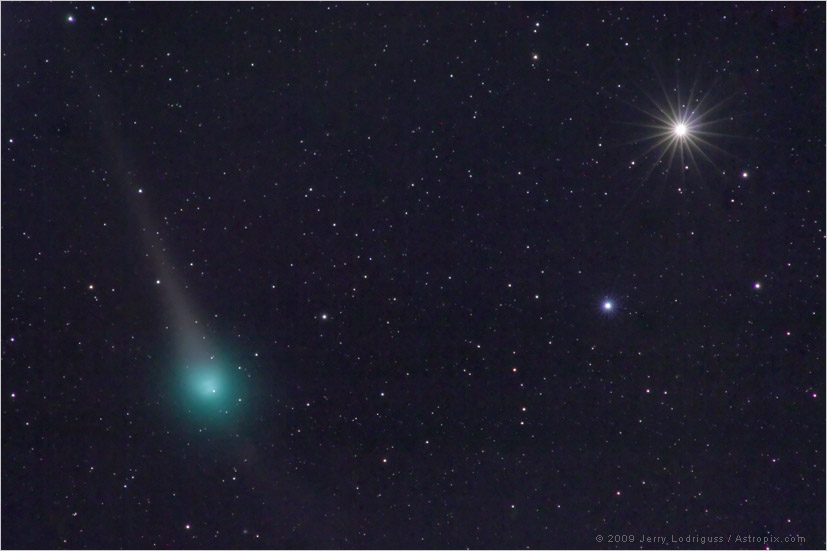
Tracking through the constellation Leo on February 23rd, bright planet Saturn and Comet Lulin were both near opposition -- opposite the Sun in planet Earth's sky. They also passed within only 2 degrees of each other creating a dramatic celestial photo-op. Comet Lulin was near its closest approach to planet Earth at the time, at a distance of some 61 million kilometers, but was orbiting in the opposite direction. As a result it swept remarkably rapidly across the background of stars. This telephoto image captures both bright Saturn and greenish Lulin in the same field in a scene not too different from binocular views. Don't recognize ringed Saturn? The rings are presently tilted nearly edge-on to our view and the brighter planet is overexposed to record details of the fainter comet. At the upper right, Saturn is marked by multiple diffraction spikes created by the aperture blades in the telephoto lens.