The Sun
The Sun is a yellow dwarf star (G2V), about 4.6 billion years old, and the dominant gravitational force in the Solar System. It has a diameter of roughly 1.4 million kilometers and contains around 99.8% of the Solar System’s mass. Nuclear fusion in its core converts hydrogen into helium, producing energy that warms the planets. Above the core lie the radiative and convective zones, followed by the visible photosphere (~5,500 °C), the chromosphere, and the much hotter corona (~2 million °C).
Source: science.nasa.gov
APODs including "The Sun"
Atlantis and Hubble Side by Side
16/05/2009
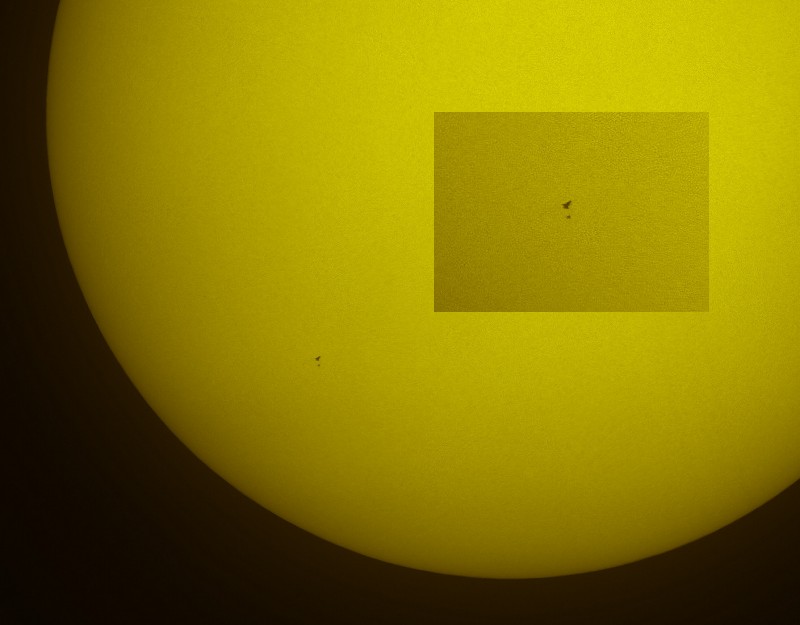
On Wednesday, May 13, two, tiny, fast moving spots crossed an otherwise featureless solar disk. Not sunspots though, the dark blemishes were silhouettes of the shuttle orbiter Atlantis and the Hubble Space Telescope side by side. To record this sharp picture of the orbiting pair against the face of the Sun, astronomer Thierry Legault carefully set up his camera and telescope near the center of a 5 kilometer wide path of visibility about 100 kilometers south of Kennedy Space Center in Florida. He opened the shutter for 1/8,000 second at 12:17 EDT, catching Atlantis and Hubble at a range of 600 kilometers while they were moving at 7 kilometers/second. The total duration of the transit (Sun crossing) was 0.8 seconds. Enlarged in the inset view, Atlantis (top) is approaching Hubble prior to capturing the space telescope. Thursday, astronauts began a series of spacewalks to perform the maintenance as part of the final mission to Hubble.