The Sun
The Sun is a yellow dwarf star (G2V), about 4.6 billion years old, and the dominant gravitational force in the Solar System. It has a diameter of roughly 1.4 million kilometers and contains around 99.8% of the Solar System’s mass. Nuclear fusion in its core converts hydrogen into helium, producing energy that warms the planets. Above the core lie the radiative and convective zones, followed by the visible photosphere (~5,500 °C), the chromosphere, and the much hotter corona (~2 million °C).
Source: science.nasa.gov
APODs including "The Sun"
Moon in the Mullica
28/05/2009
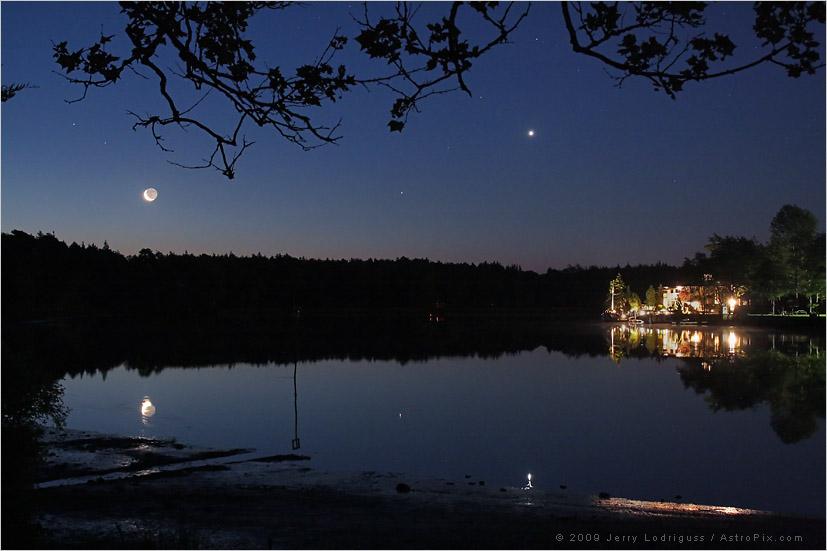
Still waters mimic a predawn sky along the eastern horizon in this peaceful scene. The picture was recorded on May 22nd from the banks of the Mullica River, in a forested region known as the Pine Barrens of southern New Jersey on the US east coast. Near the horizon at the left is an old Moon with its narrow, sunlit crescent. Mars is near picture center and brilliant Venus shines farther right. Like the terrestrial lights along the riverbank, the bright celestial beacons are all reflected in the watery foreground. Of course, most of the Moon is illuminated by Earthshine, light reflected from the sunlit side of planet Earth itself, revealing features on the darkened lunar surface.