The Sun
The Sun is a yellow dwarf star (G2V), about 4.6 billion years old, and the dominant gravitational force in the Solar System. It has a diameter of roughly 1.4 million kilometers and contains around 99.8% of the Solar System’s mass. Nuclear fusion in its core converts hydrogen into helium, producing energy that warms the planets. Above the core lie the radiative and convective zones, followed by the visible photosphere (~5,500 °C), the chromosphere, and the much hotter corona (~2 million °C).
Source: science.nasa.gov
APODs including "The Sun"
Sunspots on a Cloudy Day
04/06/2009
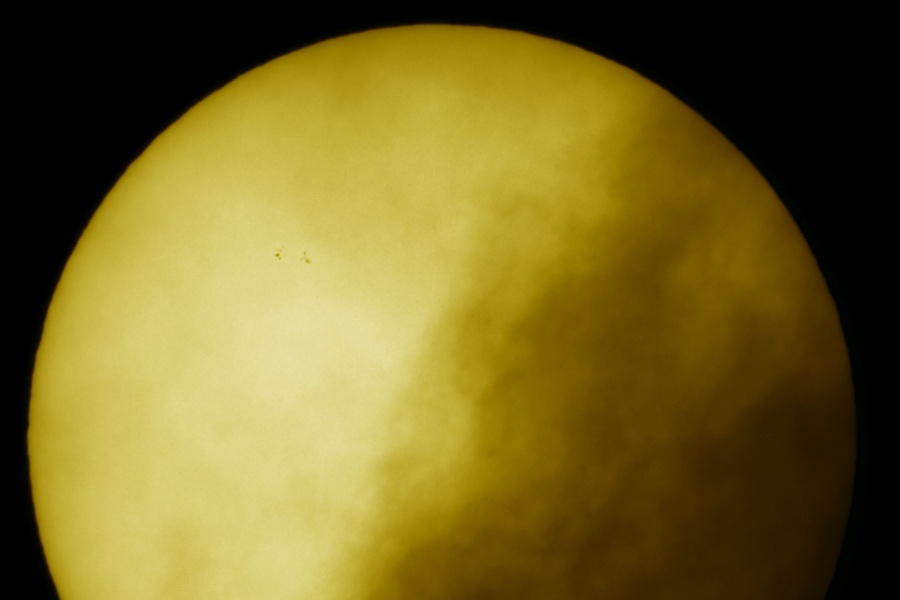
On June 2nd, clouds over Stuttgart, Germany parted to reveal what has become a relatively rare sight, spots on the Sun. In fact, the roughly 11-year solar activity cycle is still in a surprisingly deep minimum and the years 2008 and 2009 have had the lowest sunspot counts since the 1950s. Even the latest prediction is that the new cycle, Solar Cycle 24, will reach a maximum in May 2013 with a below-average sunspot count. The Solar Cycle 24 sunspots recorded here are in active region AR 1019. Previously, only two cycle 24 active regions with sunspots, AR 1018 and AR 1017, were seen in May.