The Sun
The Sun is a yellow dwarf star (G2V), about 4.6 billion years old, and the dominant gravitational force in the Solar System. It has a diameter of roughly 1.4 million kilometers and contains around 99.8% of the Solar System’s mass. Nuclear fusion in its core converts hydrogen into helium, producing energy that warms the planets. Above the core lie the radiative and convective zones, followed by the visible photosphere (~5,500 °C), the chromosphere, and the much hotter corona (~2 million °C).
Source: science.nasa.gov
APODs including "The Sun"
Noctilucent Cloud Storm Panorama
11/07/2009
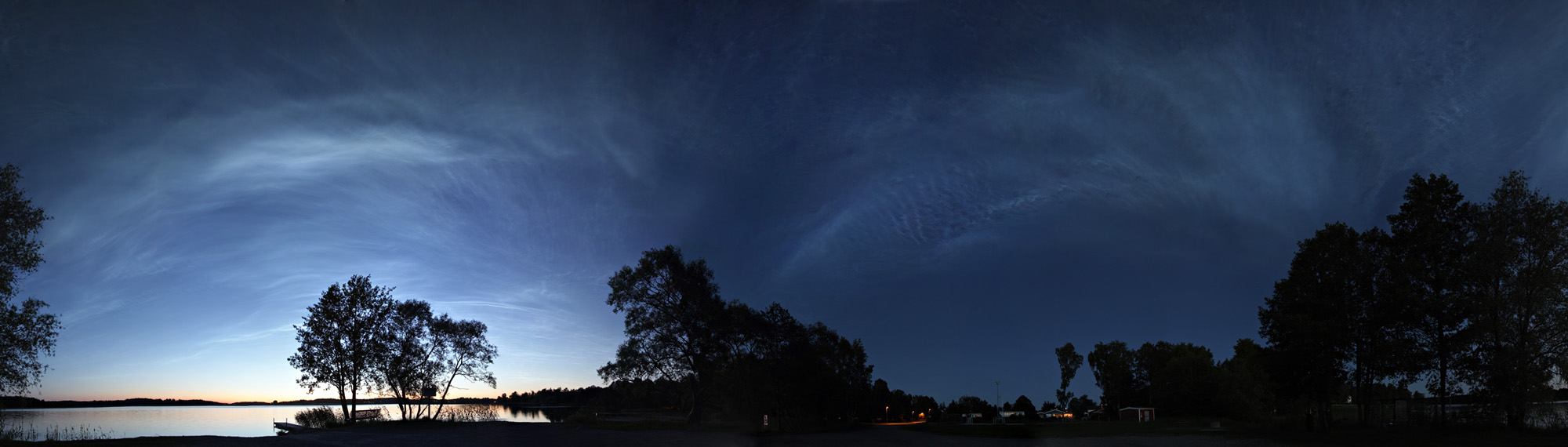
Noctilucent or night-shining clouds lie near the edge of space. From about 80 kilometers above Earth's surface, the icy clouds can still reflect sunlight even though the Sun itself is below the horizon as seen from the ground. Usually occurring at high latitudes in summer months, the diaphanous apparitions are also known as polar mesospheric clouds and may be connected to global change in the lower atmosphere. This impressive 360 degree panorama made from 34 separate images captures an impressive display of noctilucent clouds all over the sky. It was recorded last month from Vallentuna, Sweden. The photographer reports that the display was like a noctilucent cloud storm, one of the best he's ever witnessed.