The Sun
The Sun is a yellow dwarf star (G2V), about 4.6 billion years old, and the dominant gravitational force in the Solar System. It has a diameter of roughly 1.4 million kilometers and contains around 99.8% of the Solar System’s mass. Nuclear fusion in its core converts hydrogen into helium, producing energy that warms the planets. Above the core lie the radiative and convective zones, followed by the visible photosphere (~5,500 °C), the chromosphere, and the much hotter corona (~2 million °C).
Source: science.nasa.gov
APODs including "The Sun"
6 Minutes 42 Seconds
30/07/2009
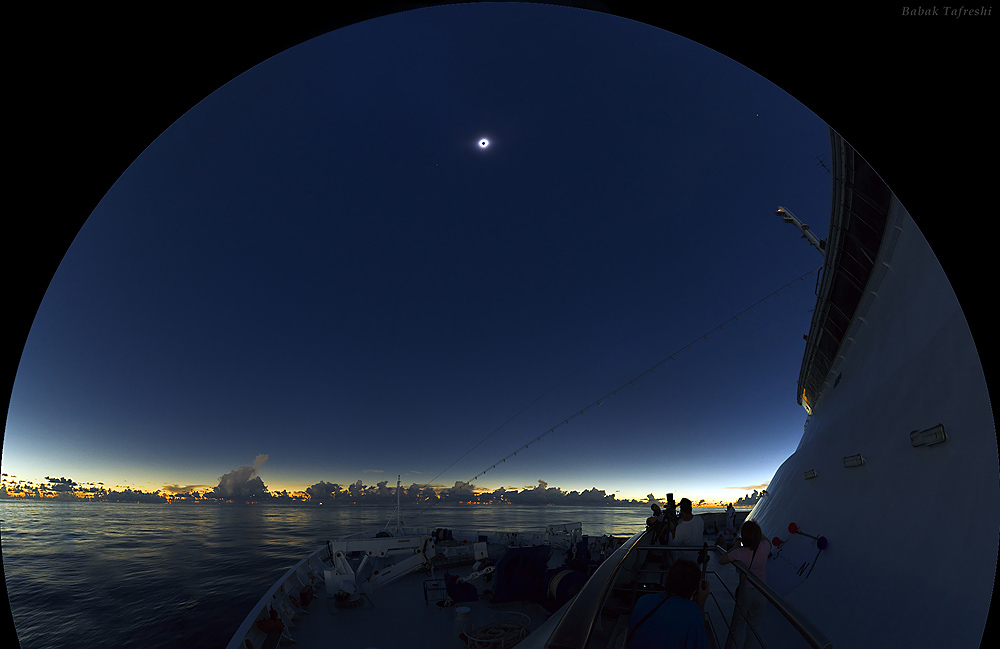
The July 22nd total solar eclipse was the longest of the 21st century. From the point of maximum eclipse along the Moon's shadow track across the Pacific Ocean, the Moon completely blocked the Sun for a total of 6 minutes and 39 seconds. But from the deck of this cruise ship the duration of the total eclipse phase was extended to a whopping 6 minutes and 42 seconds by the ship's motion along the shadow track. This panoramic view of the scene shows the shimmering solar corona in a darkened daytime sky, with clouds silhouetted by a bright sky on the distant horizon, beyond the Moon's shadow. Mercury can be seen near the eclipsed Sun. Venus lies near the upper right edge of the frame.