The Sun
The Sun is a yellow dwarf star (G2V), about 4.6 billion years old, and the dominant gravitational force in the Solar System. It has a diameter of roughly 1.4 million kilometers and contains around 99.8% of the Solar System’s mass. Nuclear fusion in its core converts hydrogen into helium, producing energy that warms the planets. Above the core lie the radiative and convective zones, followed by the visible photosphere (~5,500 °C), the chromosphere, and the much hotter corona (~2 million °C).
Source: science.nasa.gov
APODs including "The Sun"
Diamonds in a Cloudy Sky
08/08/2009
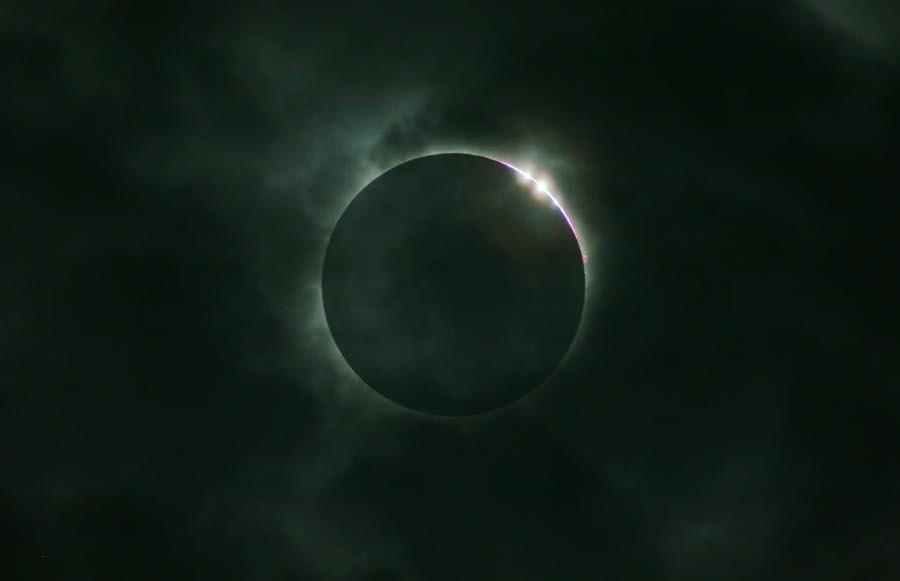
Cloudy skies over Wuhan, China hid the delicate solar corona during July's total eclipse of the Sun. Still, the Moon's silhouette was highlighted by these glistening diamonds as the total eclipse phase ended. Caused by bright sunlight streaming through dips and valleys in the irregular terrain along the Moon's edge, the effect is known as Baily's Beads, named after Francis Baily who called attention to the phenomenon in 1836. The dramatic appearance of the beads at the beginning or end of a total solar eclipse is also known as the Diamond Ring effect. In this remarkable image, a small, pinkish solar prominence can also be seen along the edge, below the diamonds.