The Sun
The Sun is a yellow dwarf star (G2V), about 4.6 billion years old, and the dominant gravitational force in the Solar System. It has a diameter of roughly 1.4 million kilometers and contains around 99.8% of the Solar System’s mass. Nuclear fusion in its core converts hydrogen into helium, producing energy that warms the planets. Above the core lie the radiative and convective zones, followed by the visible photosphere (~5,500 °C), the chromosphere, and the much hotter corona (~2 million °C).
Source: science.nasa.gov
APODs including "The Sun"
A Solar Prominence Erupts in STEREO
20/10/2009
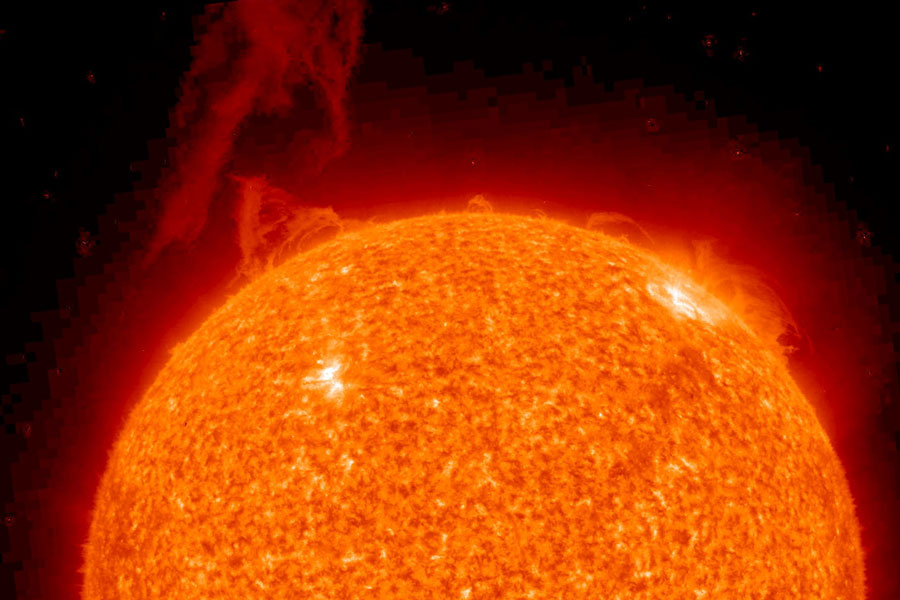
What does a solar prominence look like in three dimensions? To help find out, NASA launched the STEREO satellites to keep a steady eye on the Sun from two different vantage points. The STEREO satellites orbit the Sun nearly along Earth's orbit, but one (dubbed Ahead) currently leads the Earth, while the other (dubbed Behind) currently trails. Three weeks ago, a powerful prominence erupted and remained above the Sun for about 30 hours, allowing the STEREO satellites to get numerous views of the prominence from different angles. Pictured above is a high-resolution image of the event from the STEREO Ahead satellite. A video of the prominence erupting as seen from both spacecraft can be found here. The unusually quiet nature of the Sun over the past two years has made large prominences like this relatively rare. The combined perspective of STEREO will help astronomers better understand the mechanisms for the creation and evolution of prominences, coronal mass ejections, and flares.