The Sun
The Sun is a yellow dwarf star (G2V), about 4.6 billion years old, and the dominant gravitational force in the Solar System. It has a diameter of roughly 1.4 million kilometers and contains around 99.8% of the Solar System’s mass. Nuclear fusion in its core converts hydrogen into helium, producing energy that warms the planets. Above the core lie the radiative and convective zones, followed by the visible photosphere (~5,500 °C), the chromosphere, and the much hotter corona (~2 million °C).
Source: science.nasa.gov
APODs including "The Sun"
Saturn After Equinox
10/11/2009
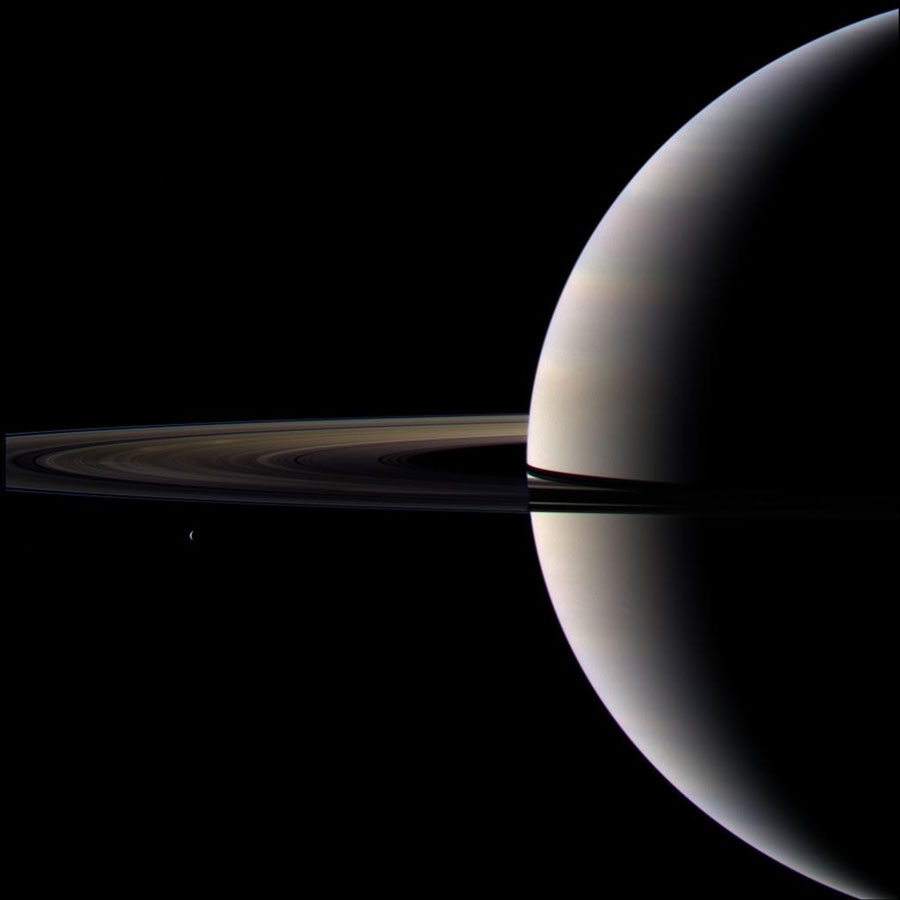
The other side of Saturn's ring plane is now directly illuminated by the Sun. For the previous 15 years, the southern side of Saturn and its rings were directly illuminated, but since Saturn's equinox in August, the orientation has reversed. Pictured above last month, the robotic Cassini spacecraft orbiting Saturn has captured the giant planet and its majestic rings soon after equinox. Imaged from nearly behind, Saturn and its moon Tethys each show a crescent phase to Cassini that is not visible from Earth. As the rings continue to point nearly toward the Sun, only a thin shadow of Saturn's rings is visible across the center of the planet. Close inspection of Saturn's rings, however, shows superposed bright features identified as spokes that are thought to be groups of very small electrically charged ice particles. Understanding the nature and dynamics of spokes is not fully understood and remains a topic of research.