The Sun
The Sun is a yellow dwarf star (G2V), about 4.6 billion years old, and the dominant gravitational force in the Solar System. It has a diameter of roughly 1.4 million kilometers and contains around 99.8% of the Solar System’s mass. Nuclear fusion in its core converts hydrogen into helium, producing energy that warms the planets. Above the core lie the radiative and convective zones, followed by the visible photosphere (~5,500 °C), the chromosphere, and the much hotter corona (~2 million °C).
Source: science.nasa.gov
APODs including "The Sun"
Young Stars in the Rho Ophiuchi Cloud
13/11/2009
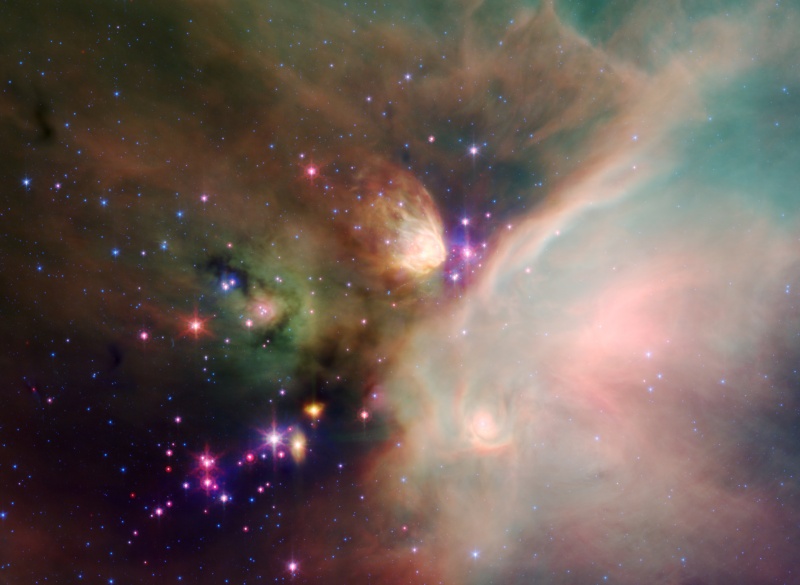
Cosmic dust clouds and embedded newborn stars glow at infrared wavelengths in this tantalizing false-color view from the Spitzer Space Telescope. Pictured is of one of the closest star forming regions, part of the Rho Ophiuchi cloud complex some 400 light-years distant near the southern edge of the pronounceable constellation Ophiuchus. The view spans about 5 light-years at that estimated distance. After forming along a large cloud of cold molecular hydrogen gas, newborn stars heat the surrounding dust to produce the infrared glow. An exploration of the region in penetrating infrared light has detected some 300 emerging and newly formed stars whose average age is estimated to be a mere 300,000 years -- extremely young compared to the Sun's age of 5 billion years.