The Sun
The Sun is a yellow dwarf star (G2V), about 4.6 billion years old, and the dominant gravitational force in the Solar System. It has a diameter of roughly 1.4 million kilometers and contains around 99.8% of the Solar System’s mass. Nuclear fusion in its core converts hydrogen into helium, producing energy that warms the planets. Above the core lie the radiative and convective zones, followed by the visible photosphere (~5,500 °C), the chromosphere, and the much hotter corona (~2 million °C).
Source: science.nasa.gov
APODs including "The Sun"
Bright Sun and Crescent Earth from the Space Station
30/11/2009
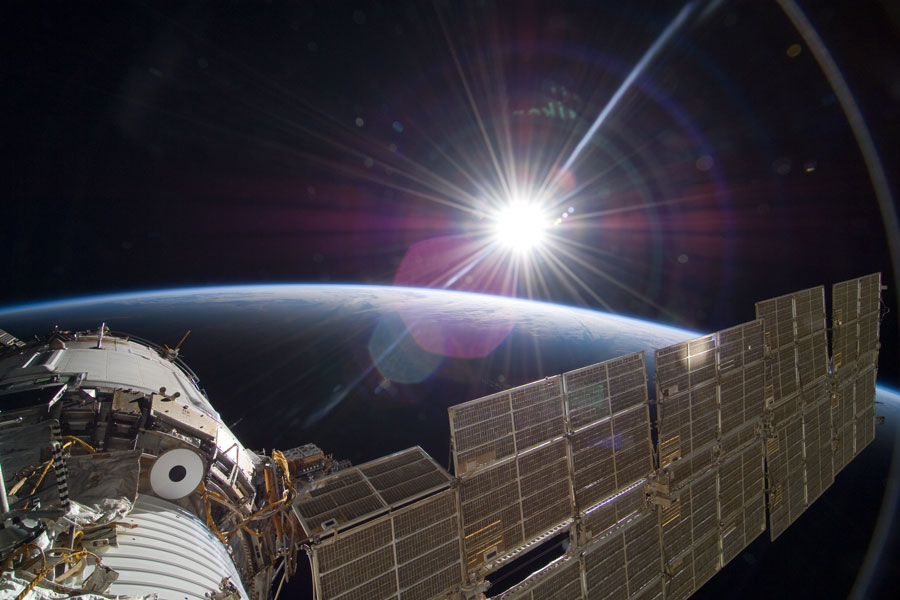
This was just one more breathtaking view from the International Space Station. The Sun, a crescent Earth, and the long arm of a solar panel were all visible outside a window when the Space Shuttle Atlantis visited the orbiting outpost last week. Reflections from the window and hexagonal lens flares from the camera are superposed. The space shuttle landed Friday after a successful 10 day mission to expand and resupply the ISS. Numbered STS-129, the space shuttle mission returned astronaut Nicole Stott to Earth from her stay on the ISS as a Flight Engineer in the Expedition 20 and 21 crews.