The Sun
The Sun is a yellow dwarf star (G2V), about 4.6 billion years old, and the dominant gravitational force in the Solar System. It has a diameter of roughly 1.4 million kilometers and contains around 99.8% of the Solar System’s mass. Nuclear fusion in its core converts hydrogen into helium, producing energy that warms the planets. Above the core lie the radiative and convective zones, followed by the visible photosphere (~5,500 °C), the chromosphere, and the much hotter corona (~2 million °C).
Source: science.nasa.gov
APODs including "The Sun"
The Spotty Surface of Betelgeuse
06/01/2010
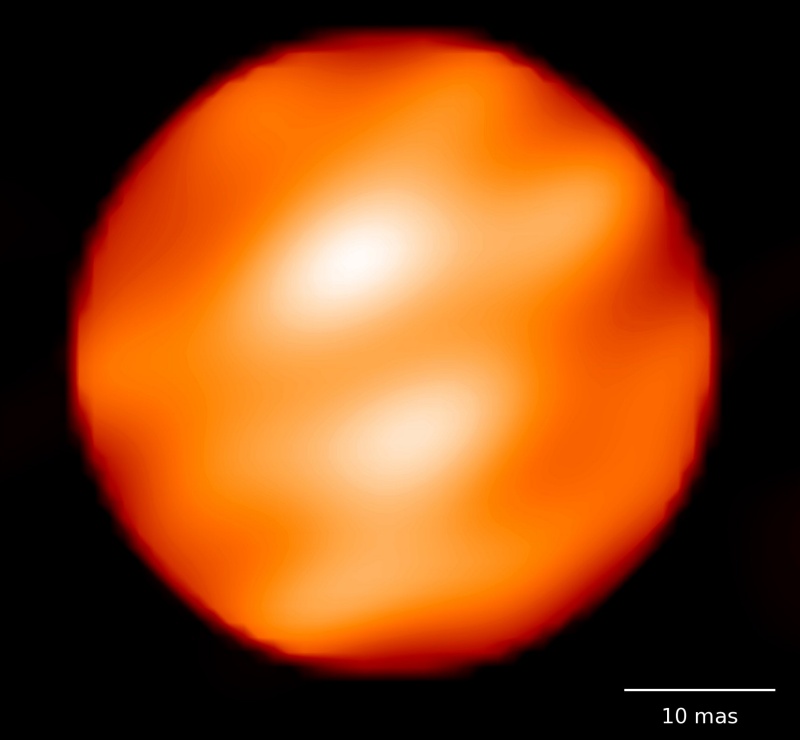
Betelgeuse really is a big star. If placed at the center of our Solar System it would extend to the orbit of Jupiter. But like all stars except the Sun, Betelgeuse is so distant it usually appears as a single point of light, even in large telescopes. Still, astronomers using interferometry at infrared wavelengths can resolve the surface of Betelgeuse and reconstructed this image of the red supergiant. The intriguing picture shows two, large, bright, star spots. The spots potentially represent enormous convective cells rising from below the supergiant's surface. They are bright because they're hotter than the rest of the surface, but both spots and surface are cooler than the Sun. Also known as Alpha Orionis, Betelgeuse is about 600 light-years away. Note: An APOD editor will review astronomy images of 2009, hosted by the Amateur Astronomers Association of New York on Friday, January 8 at the American Museum of Natural History, NYC.