The Sun
The Sun is a yellow dwarf star (G2V), about 4.6 billion years old, and the dominant gravitational force in the Solar System. It has a diameter of roughly 1.4 million kilometers and contains around 99.8% of the Solar System’s mass. Nuclear fusion in its core converts hydrogen into helium, producing energy that warms the planets. Above the core lie the radiative and convective zones, followed by the visible photosphere (~5,500 °C), the chromosphere, and the much hotter corona (~2 million °C).
Source: science.nasa.gov
APODs including "The Sun"
Pillar at Sunset
06/03/2010
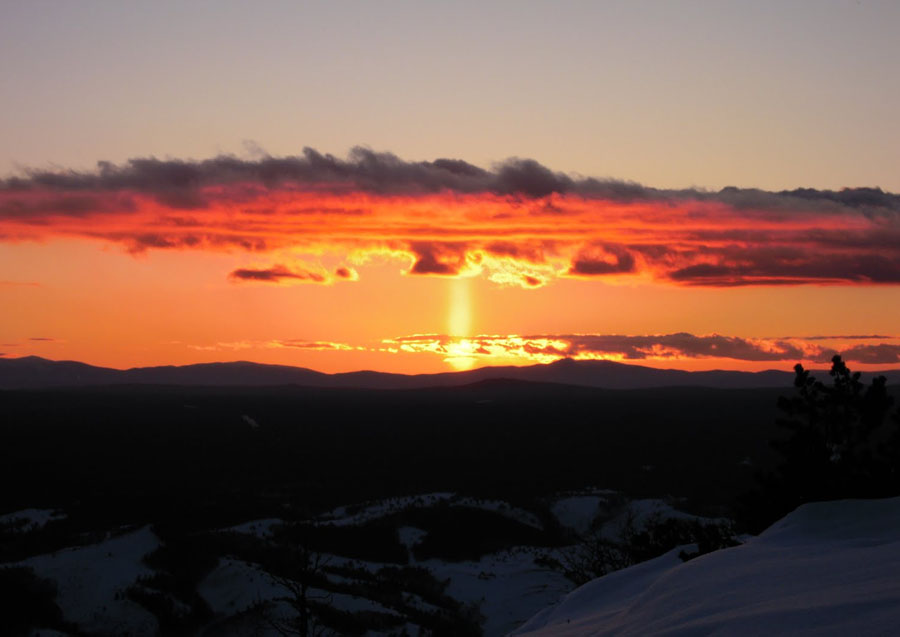
Reddened light from the setting Sun illuminates the cloud banks hugging this snowy, rugged terrain. Inspiring a moment of quiet contemplation, the sunset scene included a remarkable pillar of light that seemed to connect the clouds in the sky with the mountains below. Known as a Sun pillar, the luminous column was produced by sunlight reflecting from flat, six-sided ice crystals formed high in the cold atmosphere and fluttering toward the ground. Last Monday, astronomers watched this Sun pillar slowly fade, as the twilight deepened and clearing, dark skies came to Mt. Jelm and the Wyoming Infrared Observatory.