The Sun
The Sun is a yellow dwarf star (G2V), about 4.6 billion years old, and the dominant gravitational force in the Solar System. It has a diameter of roughly 1.4 million kilometers and contains around 99.8% of the Solar System’s mass. Nuclear fusion in its core converts hydrogen into helium, producing energy that warms the planets. Above the core lie the radiative and convective zones, followed by the visible photosphere (~5,500 °C), the chromosphere, and the much hotter corona (~2 million °C).
Source: science.nasa.gov
APODs including "The Sun"
Hesiodus Sunrise Ray
27/03/2010
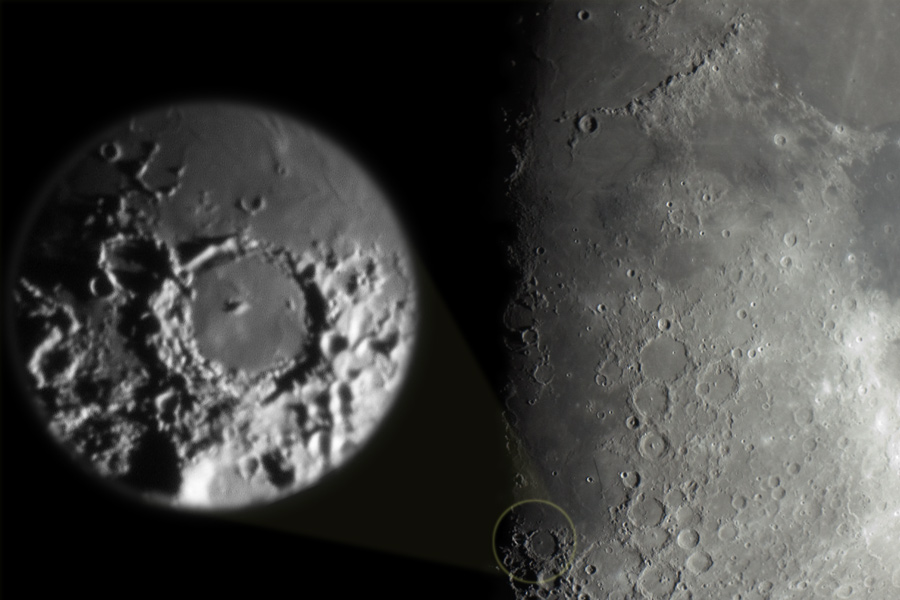
Stark shadows of mountains and crater walls stand out along the lunar terminator, or shadow line between night and day, in this telescopic image. Of course, if viewed from the lunar surface near the terminator line, the Sun would be rising and still close to the lunar horizon. But the picture's inset at the left highlights a more elusive lunar sunrise phenomenon. Streaming through a gap in the eastern wall of 45 kilometer wide Hesiodus crater, the low-angle sunlight produces a long sunrise ray playing along the otherwise shadowed crater floor. Sunrise rays are short-lived and can be rewarding to spot for Moon enthusiasts with telescopes. Seen in Hesiodus and other craters, the ray timing can be calculated based on the observer's location. This picture of a first quarter Moon was recorded at 23:45 UT on February 22nd from Stuttgart, Germany. In the inset, the larger crater Pitatus is at the right. For location, Hesiodus and Pitatus are circled at the bottom of the picture.