The Sun
The Sun is a yellow dwarf star (G2V), about 4.6 billion years old, and the dominant gravitational force in the Solar System. It has a diameter of roughly 1.4 million kilometers and contains around 99.8% of the Solar System’s mass. Nuclear fusion in its core converts hydrogen into helium, producing energy that warms the planets. Above the core lie the radiative and convective zones, followed by the visible photosphere (~5,500 °C), the chromosphere, and the much hotter corona (~2 million °C).
Source: science.nasa.gov
APODs including "The Sun"
Venus and Mercury in the West
07/04/2010
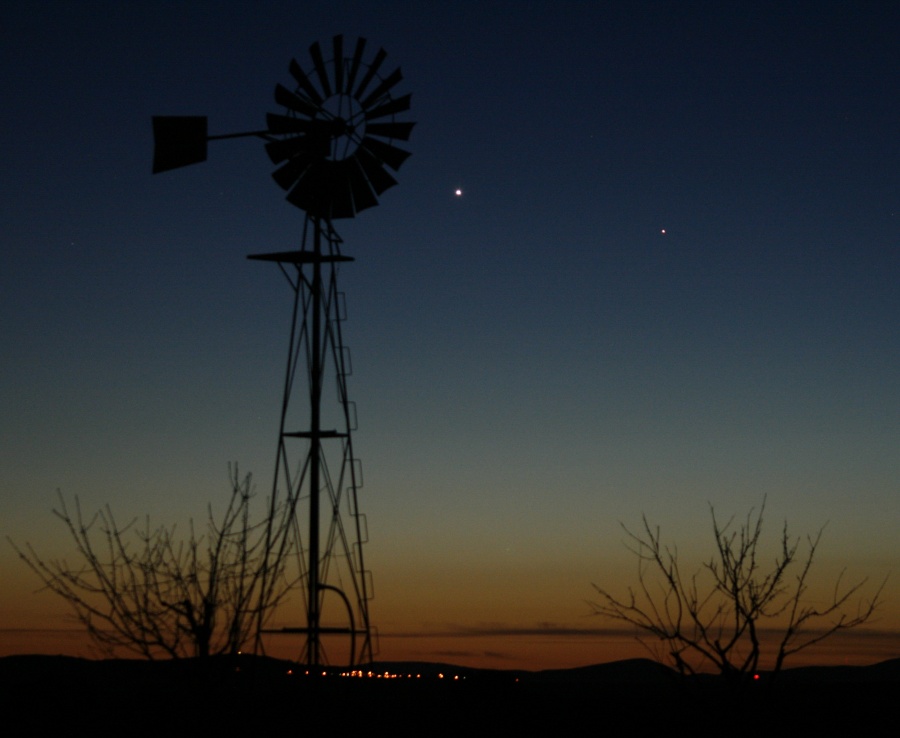
In this twilight skyview, a windmill stands in silent witness to a lovely pairing of planets in the west. The picture was recorded on April 5 from Gallegos del Campo, Zamora, Spain. Venus (left) and Mercury (right) are near their much anticipated conjunction in the early evening sky. But even in the coming days, these two evening stars will remain close in the western sky at sunset. In fact, with brighter Venus as a marker, sky watchers will have an excellent guide for spotting Mercury nearby, a planet often hidden in the Sun's glare.