The Sun
The Sun is a yellow dwarf star (G2V), about 4.6 billion years old, and the dominant gravitational force in the Solar System. It has a diameter of roughly 1.4 million kilometers and contains around 99.8% of the Solar System’s mass. Nuclear fusion in its core converts hydrogen into helium, producing energy that warms the planets. Above the core lie the radiative and convective zones, followed by the visible photosphere (~5,500 °C), the chromosphere, and the much hotter corona (~2 million °C).
Source: science.nasa.gov
APODs including "The Sun"
Bright Points on the Quiet Sun
16/04/2010
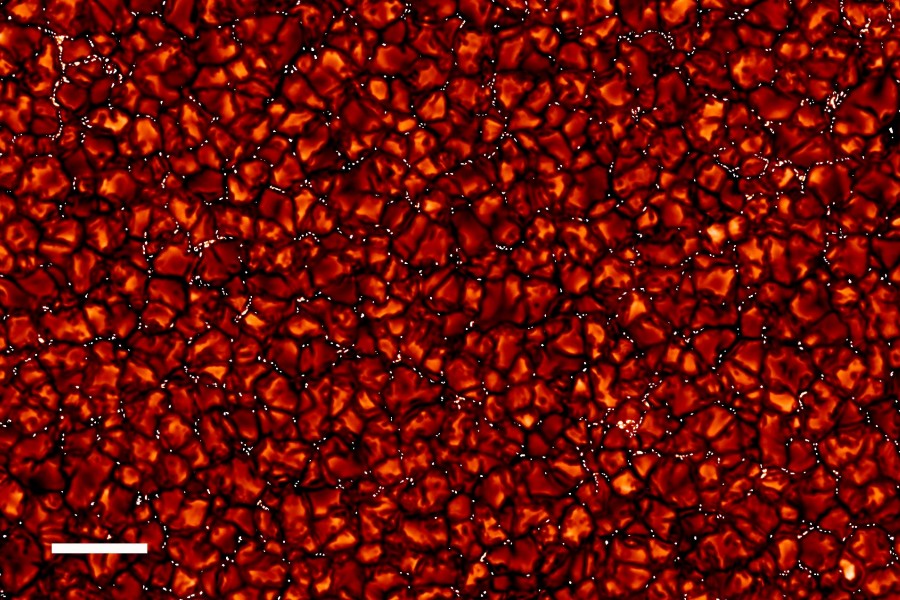
Up close, the solar surface is a striking patch work of granules in this very high resolution picture of the quiet Sun. Caused by convection, the granules are hot, rising columns of plasma edged by dark lanes of cooler, descending plasma. But the high-resolution view reveals that the dark lanes are dotted with many small, contrasting bright points. Constantly present on the solar surface, the bright points do not seem to be related to sunspots that come and go with the magnetic solar cycle. Nonetheless, the bright points are regions of concentrated magnetic fields and are bright because the magnetic pressure opens a window to hotter deeper layers below the photosphere. For scale, the white bar at the lower left corresponds to 5,000 kilometers across the Sun's surface. The sharp, narrow-band image was recorded in September, 2007 using the Swedish Solar Telescope on the astronomical island of La Palma.