The Sun
The Sun is a yellow dwarf star (G2V), about 4.6 billion years old, and the dominant gravitational force in the Solar System. It has a diameter of roughly 1.4 million kilometers and contains around 99.8% of the Solar System’s mass. Nuclear fusion in its core converts hydrogen into helium, producing energy that warms the planets. Above the core lie the radiative and convective zones, followed by the visible photosphere (~5,500 °C), the chromosphere, and the much hotter corona (~2 million °C).
Source: science.nasa.gov
APODs including "The Sun"
The Faces of Mars
05/05/2010
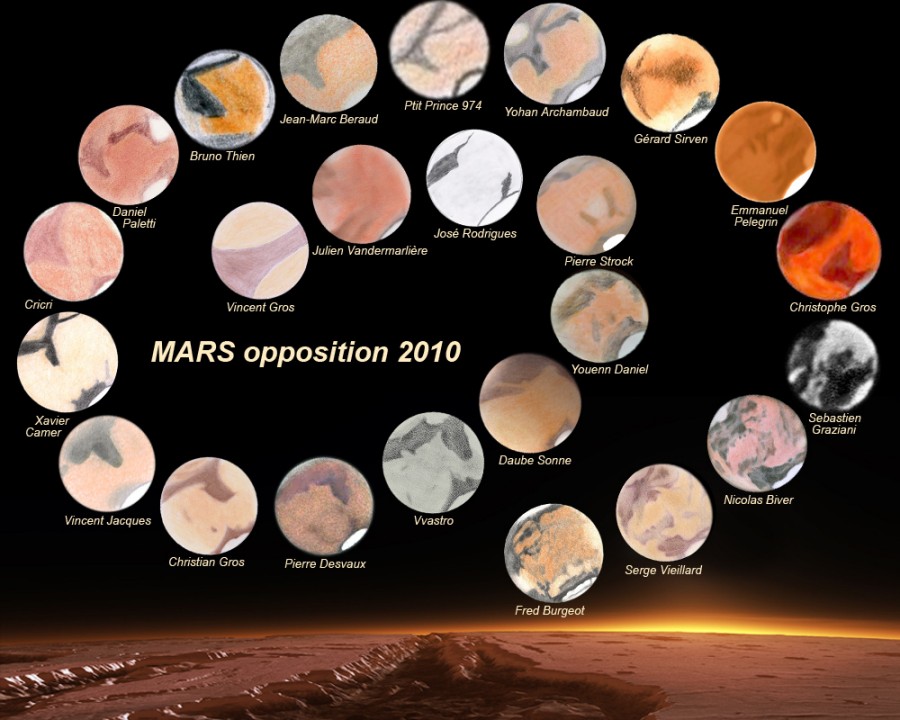
husiastic astro-artists ranging from expert to beginner, the youngest age 10, all contributed their work to this entertaining panel featuring different faces of Mars. Their sketches are all based on telescopic views of the Red Planet from earlier this year, near its 2010 opposition. Mars offers the best telescopic views at opposition, since that's when it is closest and opposite the Sun in planet Earth's sky. Arranged in a spiral pattern, the sketches are positioned to follow the planet's rotation. No canals are visible(!), but large surface markings such as the dramatic, dark Syrtis Major are easily identified. As often seen through an astronomical telescope eyepiece, the planet's orientation is inverted, with Mars' north polar cap at the bottom.