The Sun
The Sun is a yellow dwarf star (G2V), about 4.6 billion years old, and the dominant gravitational force in the Solar System. It has a diameter of roughly 1.4 million kilometers and contains around 99.8% of the Solar System’s mass. Nuclear fusion in its core converts hydrogen into helium, producing energy that warms the planets. Above the core lie the radiative and convective zones, followed by the visible photosphere (~5,500 °C), the chromosphere, and the much hotter corona (~2 million °C).
Source: science.nasa.gov
APODs including "The Sun"
Station and Shuttle Transit the Sun
23/05/2010
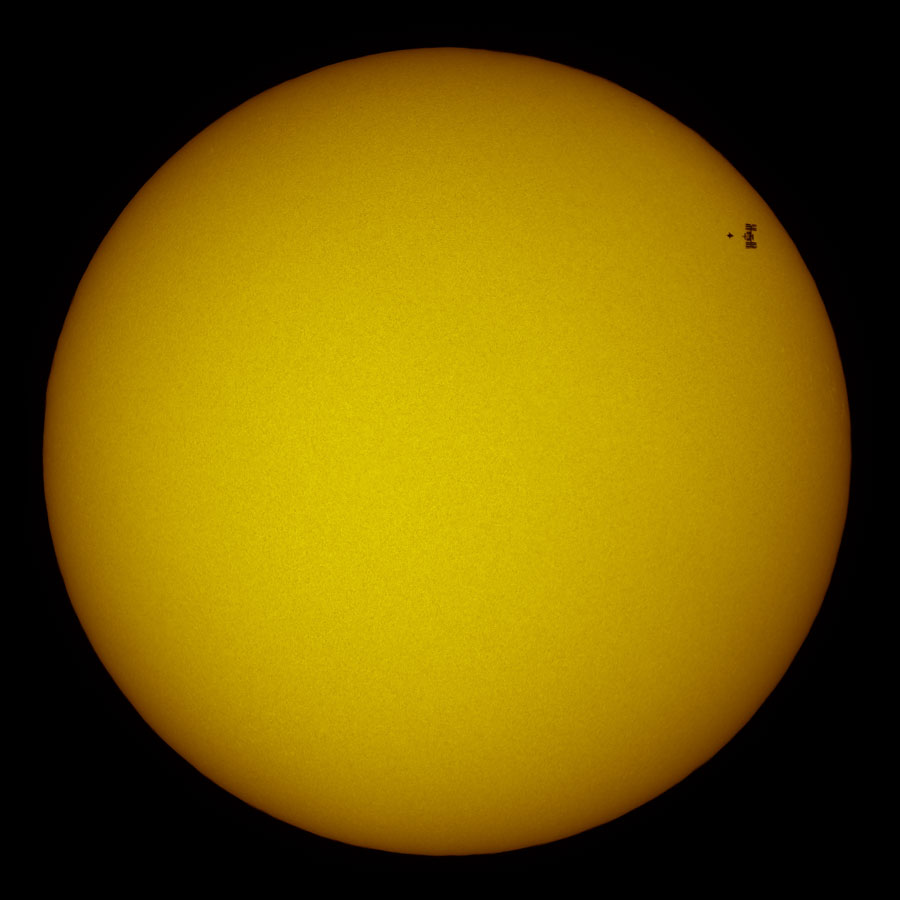
That's no sunspot. On the upper right of the above image of the Sun, the dark patches are actually the International Space Station (ISS) and the Space Shuttle Atlantis on mission STS-132. In the past, many skygazers have spotted the space station and space shuttles as bright stars gliding through twilight skies, still glinting in the sunlight while orbiting about 350 kilometers above the Earth's surface. But here, astrophotographer Thierry Lagault accurately computed the occurrence of a rarer opportunity to record the spacefaring combination moving quickly in silhouette across the solar disk. He snapped the above picture on last Sunday on May 16, about 50 minutes before the shuttle docked with the space station. Atlantis was recently launched to the ISS for its last mission before being retired.