The Sun
The Sun is a yellow dwarf star (G2V), about 4.6 billion years old, and the dominant gravitational force in the Solar System. It has a diameter of roughly 1.4 million kilometers and contains around 99.8% of the Solar System’s mass. Nuclear fusion in its core converts hydrogen into helium, producing energy that warms the planets. Above the core lie the radiative and convective zones, followed by the visible photosphere (~5,500 °C), the chromosphere, and the much hotter corona (~2 million °C).
Source: science.nasa.gov
APODs including "The Sun"
Orange Sun Simmering
09/06/2010
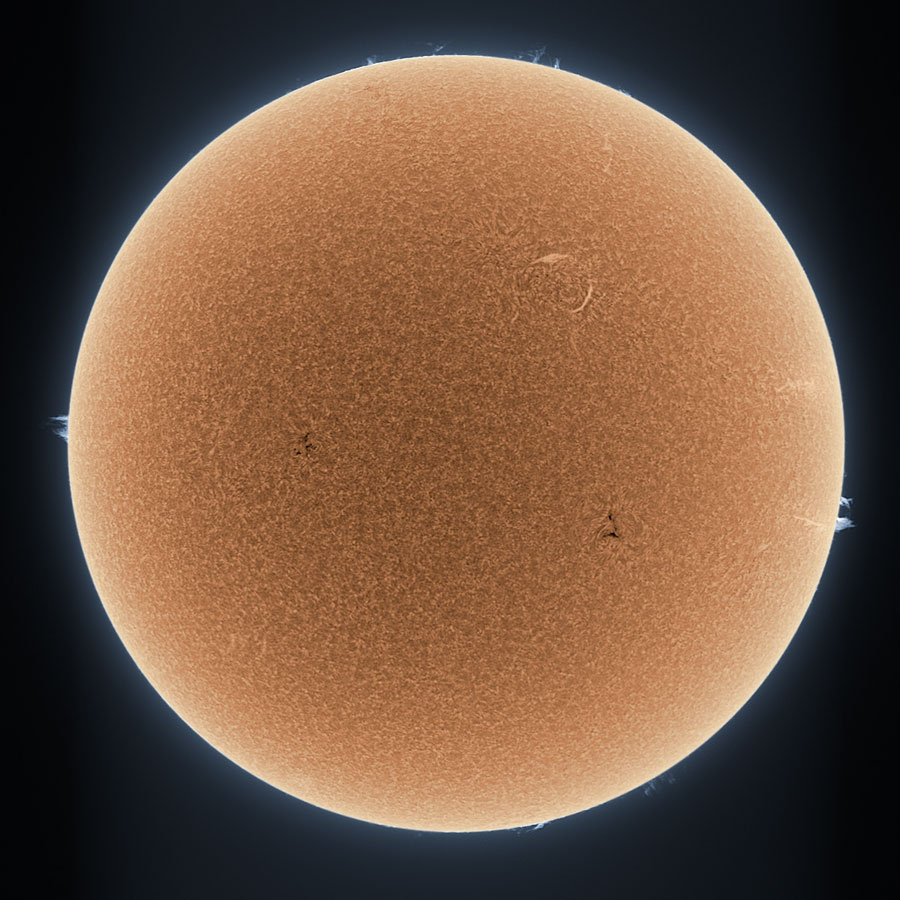
ven a quiet Sun can be a busy place. And over the deep Solar Minimum of the past few years, our Sun has been unusually quiet. The above image, taken last week in a single color of light called Hydrogen Alpha and then false colored, records a great amount of detail of the simmering surface of our parent star. The gradual brightening towards the Sun's edge in this color-inverted image, called limb darkening, is caused by increased absorption of relatively cool solar gas. Just over the Sun's edges, several prominences are visible, while two prominences on the Sun's face are seen as light streaks just above and right of the image center. Two particularly active areas of the Sun are marked by dark plages. In contrast to recent quiet times, our Sun is moving toward Solar Maximum, and for years will likely appear much more active.