The Sun
The Sun is a yellow dwarf star (G2V), about 4.6 billion years old, and the dominant gravitational force in the Solar System. It has a diameter of roughly 1.4 million kilometers and contains around 99.8% of the Solar System’s mass. Nuclear fusion in its core converts hydrogen into helium, producing energy that warms the planets. Above the core lie the radiative and convective zones, followed by the visible photosphere (~5,500 °C), the chromosphere, and the much hotter corona (~2 million °C).
Source: science.nasa.gov
APODs including "The Sun"
Comet McNaught Passes NGC 1245
17/06/2010
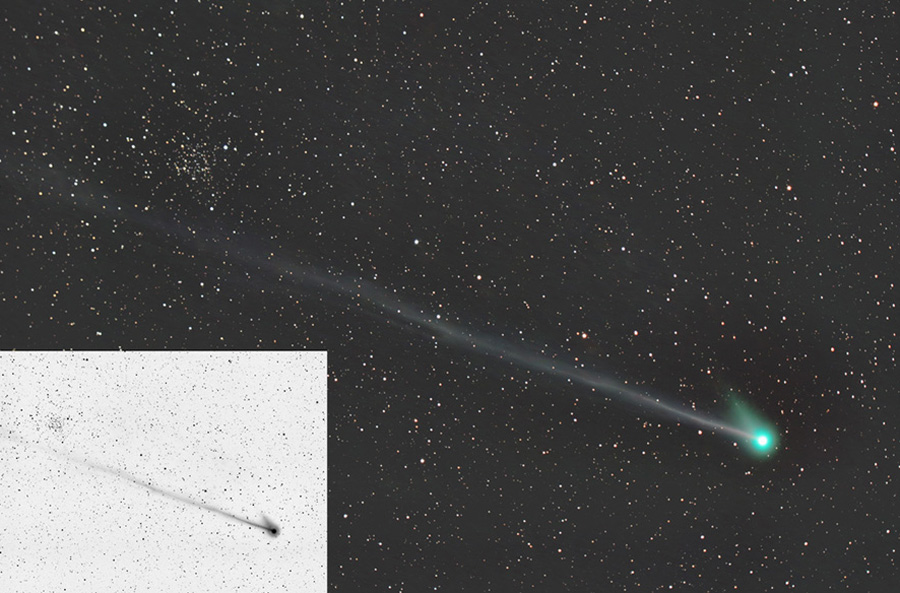
Of the many comets named for discoverer Robert McNaught, the one cataloged as C/2009 R1 is gracing dawn skies for northern hemisphere observers this month. Seen here on June 13th from southern New Mexico, this Comet McNaught's long ion tail sweeps across the telescopic field of view (a negative image is inset). Remarkably, the ion tail easily stretches past background star cluster NGC 1245 (upper left) in the constellation Perseus, about 1.5 degrees from the comet's lovely greenish head or coma. The coma also sports a short, stubby, dust tail. Of course, the comet and background stars move at different rates through planet Earth's skies. But a digital processing of many short exposures allowed frames of comet and stars to be separated, registered, and recombined in the final image. To see the comet separate from the background stars, just slide your cursor over the image. The recombined frames show off both the rich star field and faint details of the comet. Easy to spot in binoculars for now, McNaught will sink into the twilight along the eastern horizon in the coming days as it heads toward perihelion (closest approach to the Sun) on July 2.