The Sun
The Sun is a yellow dwarf star (G2V), about 4.6 billion years old, and the dominant gravitational force in the Solar System. It has a diameter of roughly 1.4 million kilometers and contains around 99.8% of the Solar System’s mass. Nuclear fusion in its core converts hydrogen into helium, producing energy that warms the planets. Above the core lie the radiative and convective zones, followed by the visible photosphere (~5,500 °C), the chromosphere, and the much hotter corona (~2 million °C).
Source: science.nasa.gov
APODs including "The Sun"
Easter Island Eclipse
14/07/2010
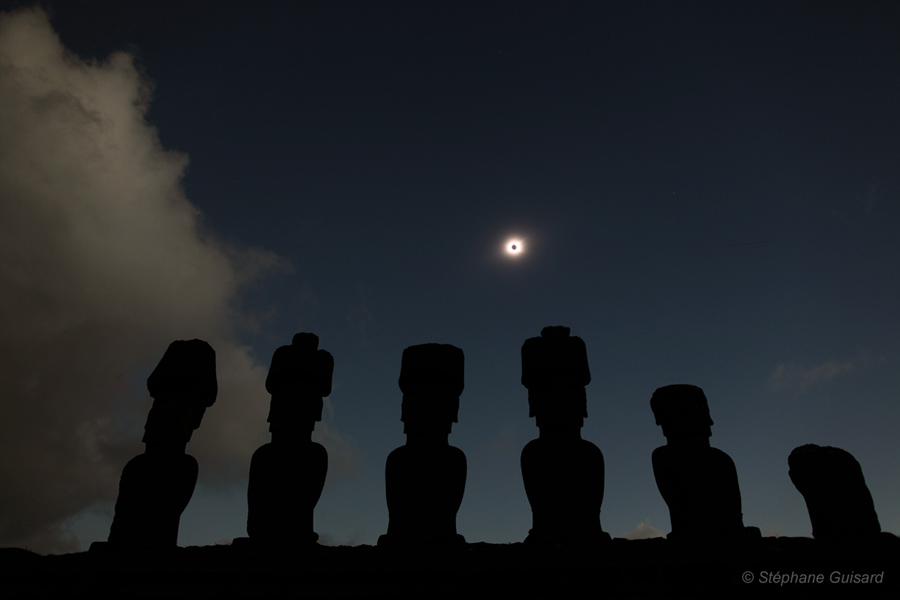
Makemake, a god in Easter Island mythology, may have smiled for a moment as clouds parted long enough to reveal this glimpse of July 11's total solar eclipse to skygazers. In the foreground of the dramatic scene, the island's famous large, monolithic statues (Moai) share a beachside view of the shimmering solar corona and the darkened daytime sky. Other opportunities to see the total phase of this eclipse of the Sun were also hard to come by. Defined by the dark part of the Moon's shadow, the path of totality tracked eastward across the southern Pacific Ocean, only making significant landfall at Mangaia (Cook Islands) and Easter Island (Isla de Pascua), ending shortly after reaching southern Chile and Argentina. But a partial eclipse phase could be enjoyed over a broader region, including many southern Pacific islands and wide swath of South America.