The Sun
The Sun is a yellow dwarf star (G2V), about 4.6 billion years old, and the dominant gravitational force in the Solar System. It has a diameter of roughly 1.4 million kilometers and contains around 99.8% of the Solar System’s mass. Nuclear fusion in its core converts hydrogen into helium, producing energy that warms the planets. Above the core lie the radiative and convective zones, followed by the visible photosphere (~5,500 °C), the chromosphere, and the much hotter corona (~2 million °C).
Source: science.nasa.gov
APODs including "The Sun"
The Crown of the Sun
21/07/2010
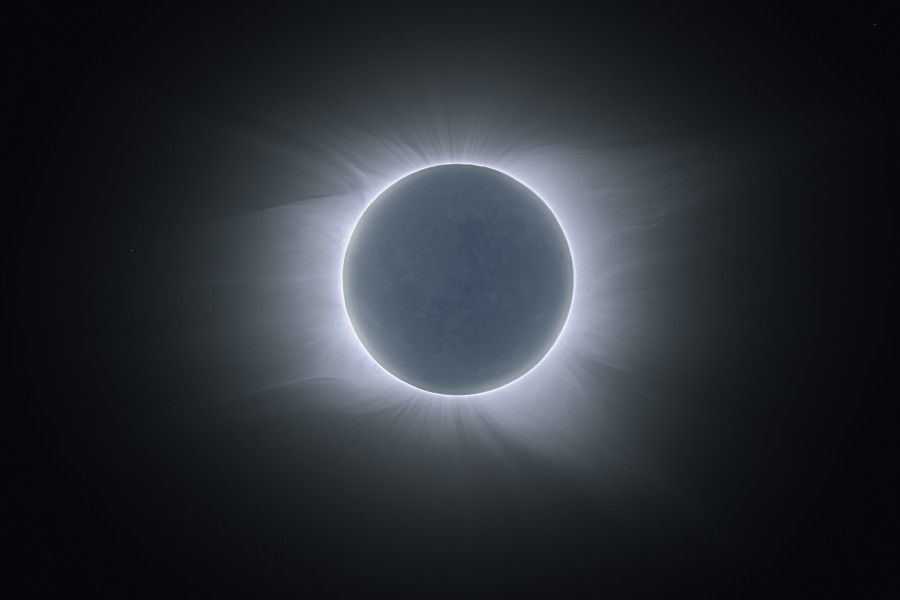
During a total solar eclipse, the Sun's extensive outer atmosphere, or corona, is an inspirational sight. Subtle shades and shimmering features that engage the eye span a brightness range of over 10,000 to 1, making them notoriously difficult to capture in a single photograph. But this composite of 7 consecutive digital images over a range of exposure times comes close to revealing the crown of the Sun in all its glory. The telescopic views were recorded from the Isla de Pascua (Easter Island) during July 11's total solar eclipse and also show solar prominences extending just beyond the edge of the eclipsed sun. Remarkably, features on the dim, near side of the New Moon can also be made out, illuminated by sunlight reflected from a Full Earth.