The Sun
The Sun is a yellow dwarf star (G2V), about 4.6 billion years old, and the dominant gravitational force in the Solar System. It has a diameter of roughly 1.4 million kilometers and contains around 99.8% of the Solar System’s mass. Nuclear fusion in its core converts hydrogen into helium, producing energy that warms the planets. Above the core lie the radiative and convective zones, followed by the visible photosphere (~5,500 °C), the chromosphere, and the much hotter corona (~2 million °C).
Source: science.nasa.gov
APODs including "The Sun"
The Not So Quiet Sun
06/08/2010
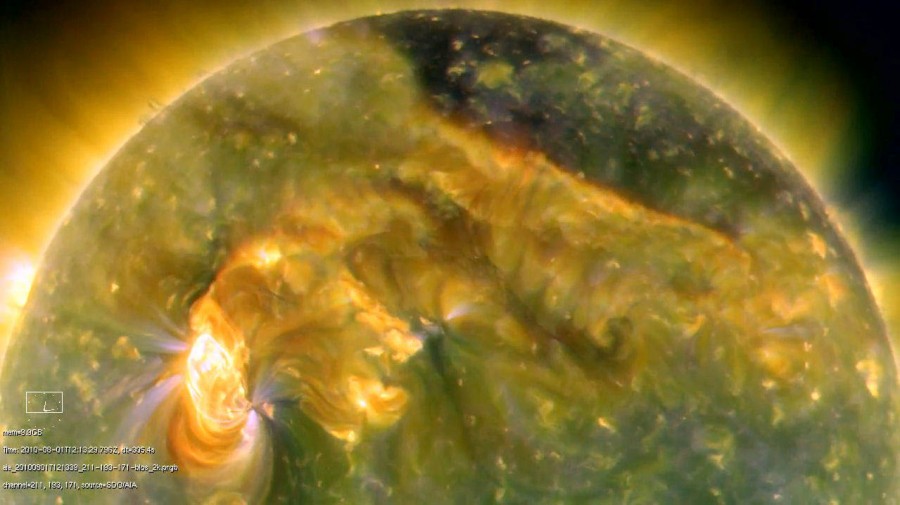
After a long solar minimum, the Sun is no longer so quiet. On August 1, this extreme ultraviolet snapshot of the Sun from the Solar Dynamics Observatory captured a complex burst of activity playing across the Sun's northern hemisphere. The false-color image shows the hot solar plasma at temperatures ranging from 1 to 2 million kelvins. Along with the erupting filaments and prominences, a small(!) solar flare spawned in the active region at the left was accompanied by a coronal mass ejection (CME), a billion-ton cloud of energetic particles headed for planet Earth. Making the 93 million mile trip in only two days, the CME impacted Earth's magnetosphere, triggering a geomagnetic storm and both northern and southern auroral displays.