The Sun
The Sun is a yellow dwarf star (G2V), about 4.6 billion years old, and the dominant gravitational force in the Solar System. It has a diameter of roughly 1.4 million kilometers and contains around 99.8% of the Solar System’s mass. Nuclear fusion in its core converts hydrogen into helium, producing energy that warms the planets. Above the core lie the radiative and convective zones, followed by the visible photosphere (~5,500 °C), the chromosphere, and the much hotter corona (~2 million °C).
Source: science.nasa.gov
APODs including "The Sun"
Crepuscular Rays Over Lake Michigan
11/08/2010
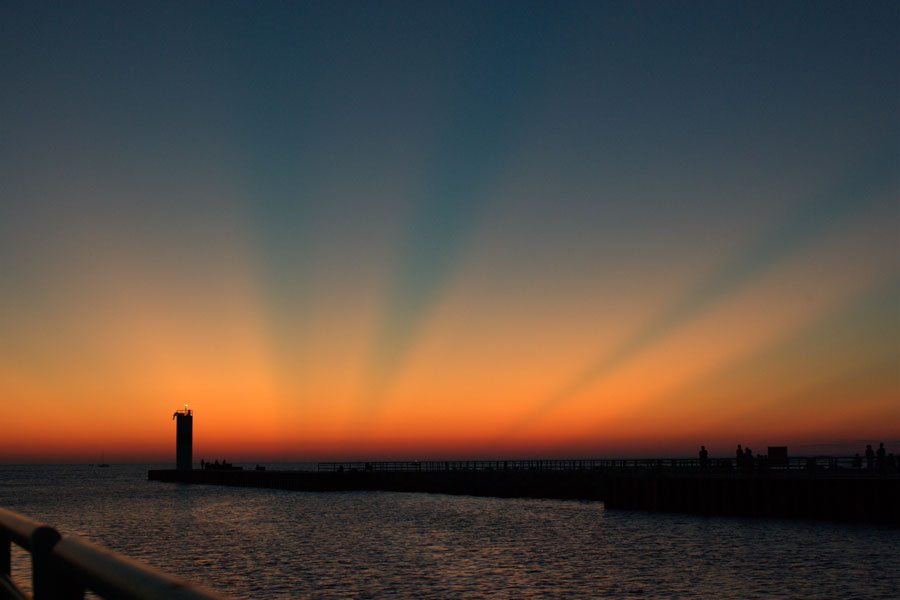
What could cause such rays of dark? Dark sky rays were caught in spectacular fashion earlier last month from Pentwater, Michigan, USA, looking west over Lake Michigan. The cause is something surprisingly familiar: shadows. Clouds near the horizon can block sunlight from reflecting off air, making columns outward from the Sun appear unusually dark. Cloud shadows can be thought of as the complement of the more commonly highlighted crepuscular rays, also visible above, where sunlight pours though cloud holes. Sometimes, on the opposite side of the sky, anticrepuscular rays can also be seen.