The Sun
The Sun is a yellow dwarf star (G2V), about 4.6 billion years old, and the dominant gravitational force in the Solar System. It has a diameter of roughly 1.4 million kilometers and contains around 99.8% of the Solar System’s mass. Nuclear fusion in its core converts hydrogen into helium, producing energy that warms the planets. Above the core lie the radiative and convective zones, followed by the visible photosphere (~5,500 °C), the chromosphere, and the much hotter corona (~2 million °C).
Source: science.nasa.gov
APODs including "The Sun"
Hole in the Sun
28/08/2010
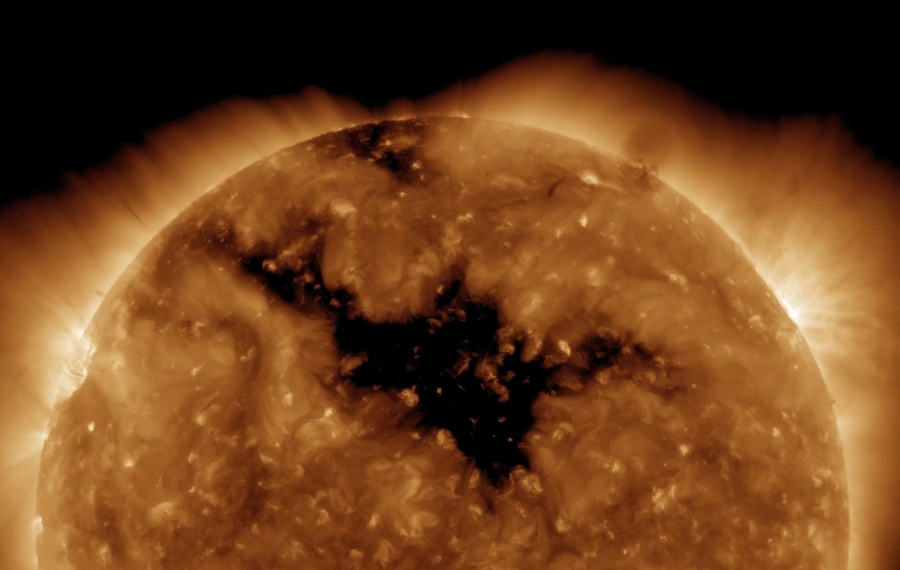
This ominous, dark shape sprawling across the face of the Sun is a coronal hole -- a low density region extending above the surface where the solar magnetic field opens freely into interplanetary space. Studied extensively from space since the 1960s in ultraviolet and x-ray light, coronal holes are known to be the source of the high-speed solar wind, atoms and electrons which flow outward along the open magnetic field lines. During periods of low activity, coronal holes typically cover regions just above the Sun's poles. But this extensive coronal hole dominated the Sun's northern hemisphere earlier this week, captured here in extreme ultraviolet light by cameras onboard the Solar Dynamics Observatory. The solar wind streaming from this coronal hole triggered auroral displays on planet Earth.