The Sun
The Sun is a yellow dwarf star (G2V), about 4.6 billion years old, and the dominant gravitational force in the Solar System. It has a diameter of roughly 1.4 million kilometers and contains around 99.8% of the Solar System’s mass. Nuclear fusion in its core converts hydrogen into helium, producing energy that warms the planets. Above the core lie the radiative and convective zones, followed by the visible photosphere (~5,500 °C), the chromosphere, and the much hotter corona (~2 million °C).
Source: science.nasa.gov
APODs including "The Sun"
Equinox and the Harvest Moon
24/09/2010
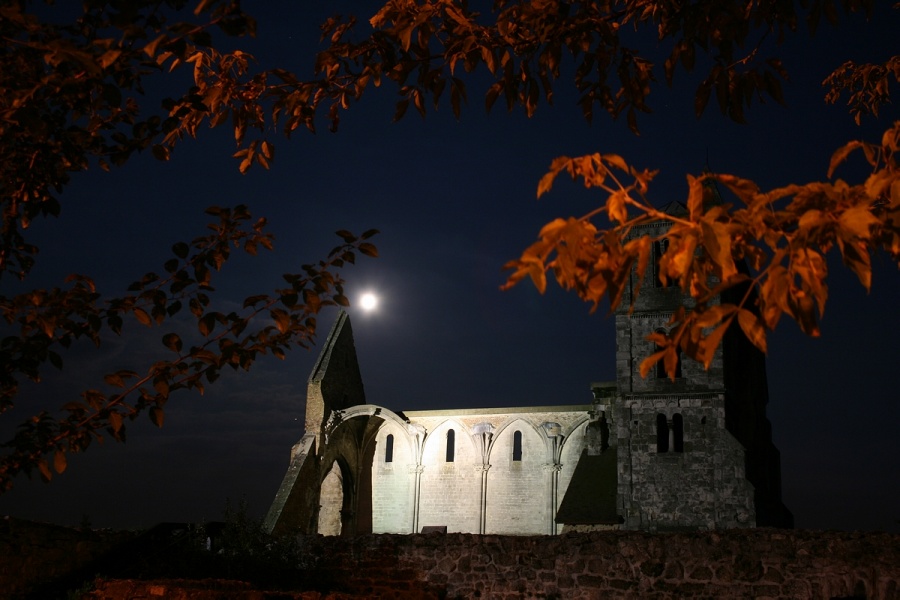
Did you enjoy the moonlight last night? The Full Moon closest to autumnal equinox and the beginning of Fall is traditionally known as the Harvest Moon, rising opposite the Sun and illuminating fields at harvest time after sunset. This year's northern hemisphere autumnal equinox occurred yesterday, September 23rd, at 03:09 Universal Time. The Moon was at its full phase a mere 6 hours later -- exceptionally close for a Harvest Moon! Of course, the Moon still shines brightly through the night in surrounding days. In this picture from September 22nd, the lunar orb dominates the sky above a ruined church in Zsámbék, Hungary. Shining nearby, the brightest star is actually Jupiter, also opposite the Sun, seen here through thin clouds just left of the church wall.