The Sun
The Sun is a yellow dwarf star (G2V), about 4.6 billion years old, and the dominant gravitational force in the Solar System. It has a diameter of roughly 1.4 million kilometers and contains around 99.8% of the Solar System’s mass. Nuclear fusion in its core converts hydrogen into helium, producing energy that warms the planets. Above the core lie the radiative and convective zones, followed by the visible photosphere (~5,500 °C), the chromosphere, and the much hotter corona (~2 million °C).
Source: science.nasa.gov
APODs including "The Sun"
Two Planet Opposition
08/10/2010
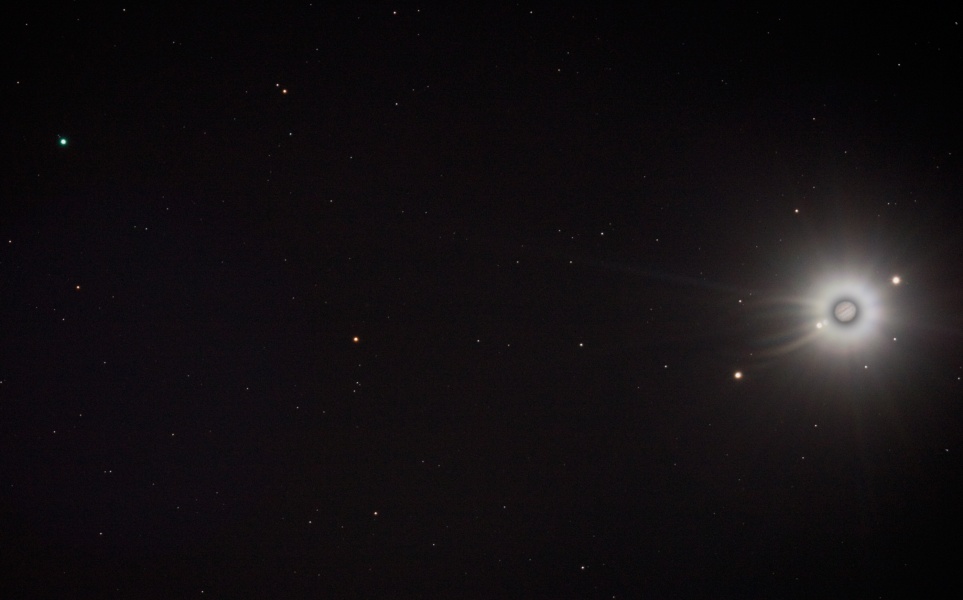
In late September, two planets were opposite the Sun in Earth's sky, Jupiter and Uranus. Consequently closest to Earth, at a distance of only 33 light-minutes and 2.65 light-hours respectively, both were good targets for telescopic observers. Recorded on September 27, this well-planned composite of consecutive multiple exposures captured both gas giants in their remarkable celestial line-up accompanied by their brighter moons. The faint greenish disk of distant planet Uranus is near the upper left corner. Of the tilted planet's 5 larger moons, two can be spotted just above and left of the planet's disk. Both discovered by 18th century British astronomer Sir William Herschel and later named for characters in Shakespeare's A Midsummer Night's Dream, Oberon is farthest left, with Titania closer in. At the right side of the frame is ruling gas giant Jupiter, flanked along a line by all four of its Galilean satellites. Farthest from Jupiter is Callisto, with Europa and Io all left of the planet's disk, while Ganymede stands alone at the right.