The Sun
The Sun is a yellow dwarf star (G2V), about 4.6 billion years old, and the dominant gravitational force in the Solar System. It has a diameter of roughly 1.4 million kilometers and contains around 99.8% of the Solar System’s mass. Nuclear fusion in its core converts hydrogen into helium, producing energy that warms the planets. Above the core lie the radiative and convective zones, followed by the visible photosphere (~5,500 °C), the chromosphere, and the much hotter corona (~2 million °C).
Source: science.nasa.gov
APODs including "The Sun"
700 Kilometers Below Comet Hartley 2
08/11/2010
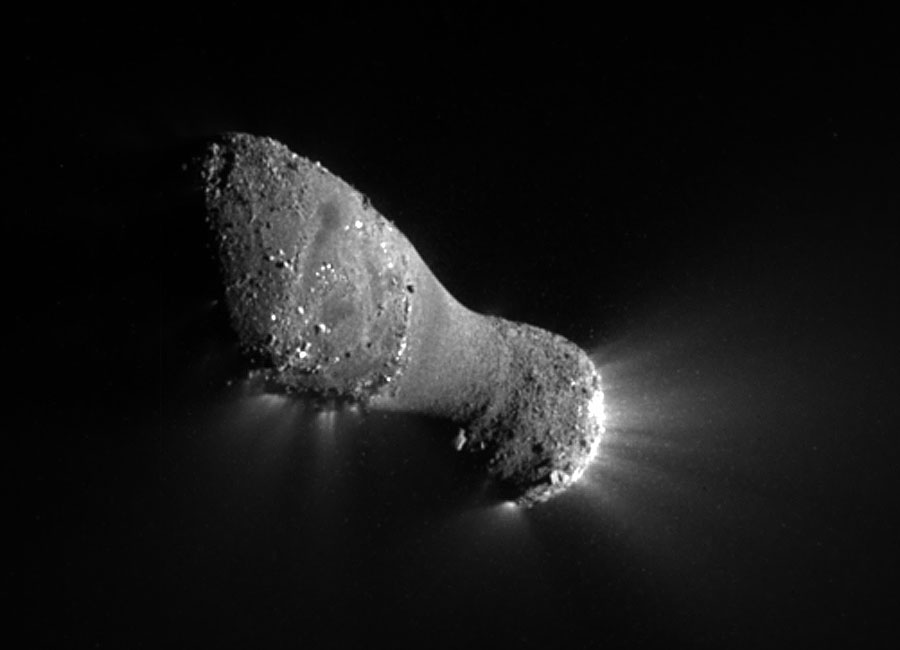
What kind of comet is this? Last week, NASA's robotic EPOXI spacecraft whizzed past Comet 103P/Hartley, also known as Comet Hartley 2, and recorded images and data that are both strange and fascinating. EPOXI was near its closest approach -- about 700 kilometers away -- when it snapped the above picture. As expected, the comet has indeed shown itself to be a tumbling iceberg orbiting the Sun between Earth and Jupiter. However, unexpected features on the images have raised many questions. For example, where are all the craters? Why is there a large smooth area around the middle? How much of Comet Hartley 2 is a loose pile of dust and ice shards? Future analyses and comparisons to other comet nuclei may answer some of these questions and, hopefully, lead to a better general understanding of comets, meteors, and the early Solar System.