The Sun
The Sun is a yellow dwarf star (G2V), about 4.6 billion years old, and the dominant gravitational force in the Solar System. It has a diameter of roughly 1.4 million kilometers and contains around 99.8% of the Solar System’s mass. Nuclear fusion in its core converts hydrogen into helium, producing energy that warms the planets. Above the core lie the radiative and convective zones, followed by the visible photosphere (~5,500 °C), the chromosphere, and the much hotter corona (~2 million °C).
Source: science.nasa.gov
APODs including "The Sun"
Eclipse at Moonset
29/12/2010
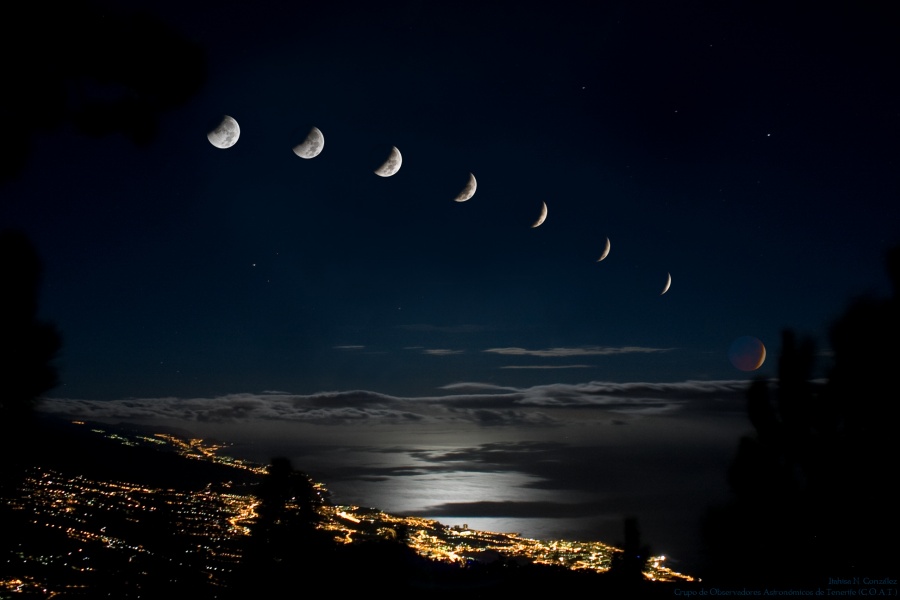
Hugging the horizon, a dark red Moon greeted early morning skygazers in eastern Atlantic regions on December 21, as the total phase of 2010's Solstice Lunar Eclipse began near moonset. This well composed image of the geocentric celestial event is a composite of multiple exposures following the progression of the eclipse from Tenerife, Canary Islands. Initially reflecting brightly on a sea of clouds and the ocean's surface itself, the Moon sinks deeper into eclipse as it moves from left to right across the sky. Opposite the Sun, the Moon was immersed in the darkest part of Earth's shadow as it approached the western horizon, just before sunrise came to Tenerife.