The Sun
The Sun is a yellow dwarf star (G2V), about 4.6 billion years old, and the dominant gravitational force in the Solar System. It has a diameter of roughly 1.4 million kilometers and contains around 99.8% of the Solar System’s mass. Nuclear fusion in its core converts hydrogen into helium, producing energy that warms the planets. Above the core lie the radiative and convective zones, followed by the visible photosphere (~5,500 °C), the chromosphere, and the much hotter corona (~2 million °C).
Source: science.nasa.gov
APODs including "The Sun"
Sunrise, Moonrise
06/01/2011
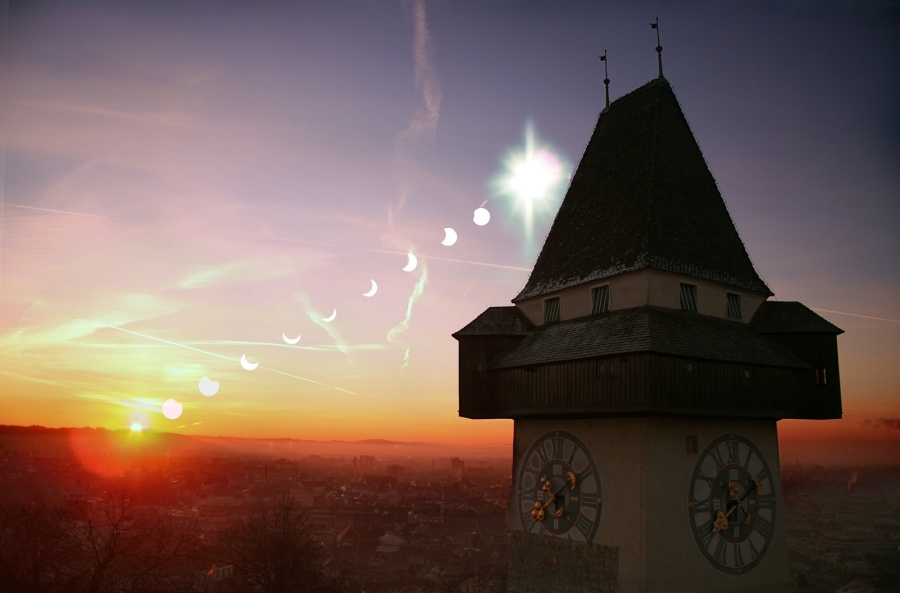
For many Europeans, the Sun and New Moon rose together on January 4 in a partial solar eclipse. Arriving close on the heels of the new year, it was the first of a series of four(!) partial solar eclipses due in 2011. This composite image documents the graceful celestial event in colorful morning skies over Graz, Austria. Beginning before sunrise, frames were taken to record the position and progress of the eclipse every 15 minutes. As Sun and Moon rose above the eastern horizon, the town of Graz is seen bathed in warming sunlight only partially blocked by the New Moon, spreading beneath the town's landmark clock tower. Best Astronomy Images: APOD Editor to speak in NYC Friday