The Sun
The Sun is a yellow dwarf star (G2V), about 4.6 billion years old, and the dominant gravitational force in the Solar System. It has a diameter of roughly 1.4 million kilometers and contains around 99.8% of the Solar System’s mass. Nuclear fusion in its core converts hydrogen into helium, producing energy that warms the planets. Above the core lie the radiative and convective zones, followed by the visible photosphere (~5,500 °C), the chromosphere, and the much hotter corona (~2 million °C).
Source: science.nasa.gov
APODs including "The Sun"
X-Class Flare
17/02/2011
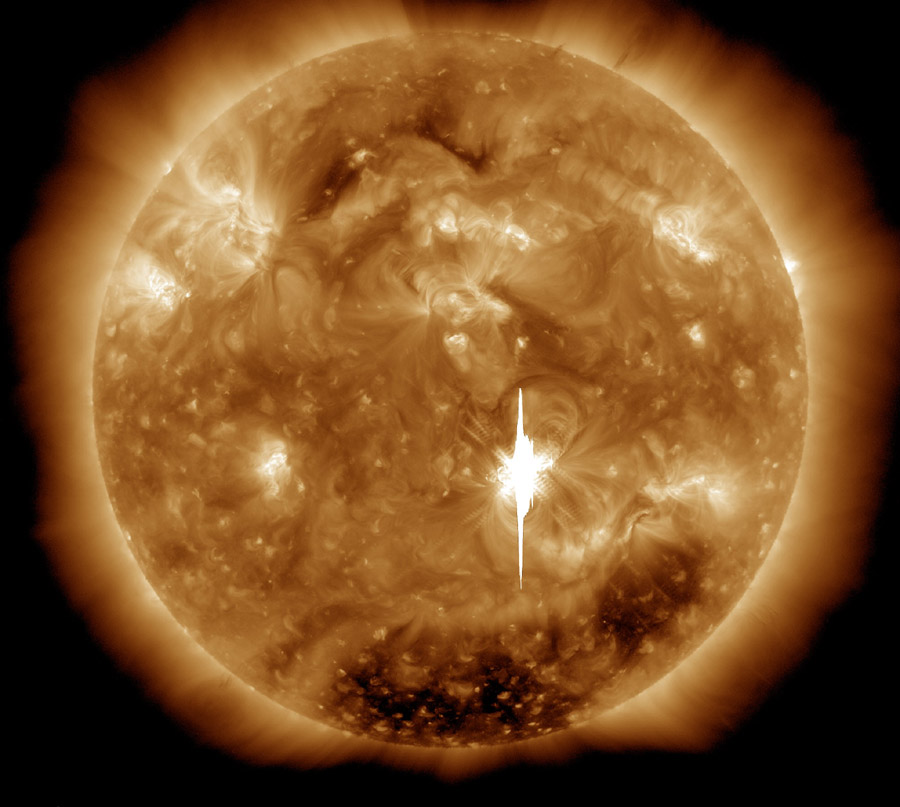
On Valentine's Day (ET) the Sun unleashed one of its most powerful explosions, an X-class flare. The blast was the largest so far in the new solar cycle. Erupting from active region AR1158 in the Sun's southern hemisphere, the flare is captured here in this extreme ultraviolet image from the Solar Dynamics Observatory (SDO). The intense burst of electromagnetic radiation momentarily overwhelmed pixels in SDO's detectors causing the bright vertical blemish. This X-class flare was also accompanied by a coronal mass ejection (CME), a massive cloud of charged particles traveling outward at nearly 900 kilometers per second. Skywatchers at high latitudes should be alert for aurorae tonight.