The Sun
The Sun is a yellow dwarf star (G2V), about 4.6 billion years old, and the dominant gravitational force in the Solar System. It has a diameter of roughly 1.4 million kilometers and contains around 99.8% of the Solar System’s mass. Nuclear fusion in its core converts hydrogen into helium, producing energy that warms the planets. Above the core lie the radiative and convective zones, followed by the visible photosphere (~5,500 °C), the chromosphere, and the much hotter corona (~2 million °C).
Source: science.nasa.gov
APODs including "The Sun"
Mercury and Jupiter at Sunset
18/03/2011
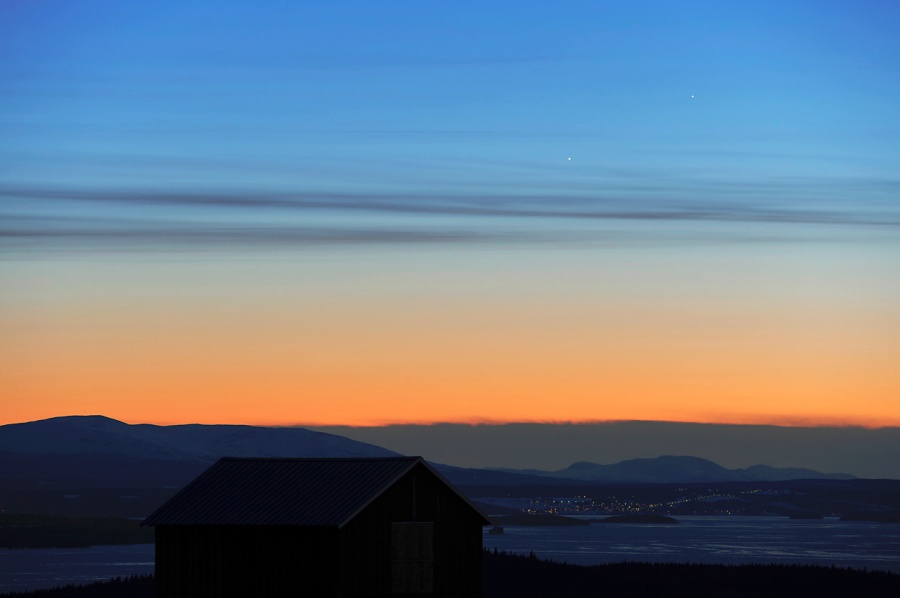
When warm sunset hues begin to fade, two celestial beacons now shine in the evening twilight, Mercury and Jupiter. Wandering away from the Sun in planet Earth's sky, Mercury will offer good views this month as spring approaches in the northern hemisphere where the ecliptic plane makes a steep angle with the western horizon. But Jupiter will continue sinking lower in the sky after sunset. In fact, the normally elusive Mercury shines well above Jupiter and the orange sunset glow in this serene sky. Captured earlier this week from the island of of Frösön in northern Sweden, the scene looks across Lake Storsjön toward the village of Hallen and distant mountains. Of course, even better views of Mercury can be had by the MESSENGER spacecraft, now orbiting the Solar System's innermost planet!