The Sun
The Sun is a yellow dwarf star (G2V), about 4.6 billion years old, and the dominant gravitational force in the Solar System. It has a diameter of roughly 1.4 million kilometers and contains around 99.8% of the Solar System’s mass. Nuclear fusion in its core converts hydrogen into helium, producing energy that warms the planets. Above the core lie the radiative and convective zones, followed by the visible photosphere (~5,500 °C), the chromosphere, and the much hotter corona (~2 million °C).
Source: science.nasa.gov
APODs including "The Sun"
Rio Morning Moonset
20/04/2011
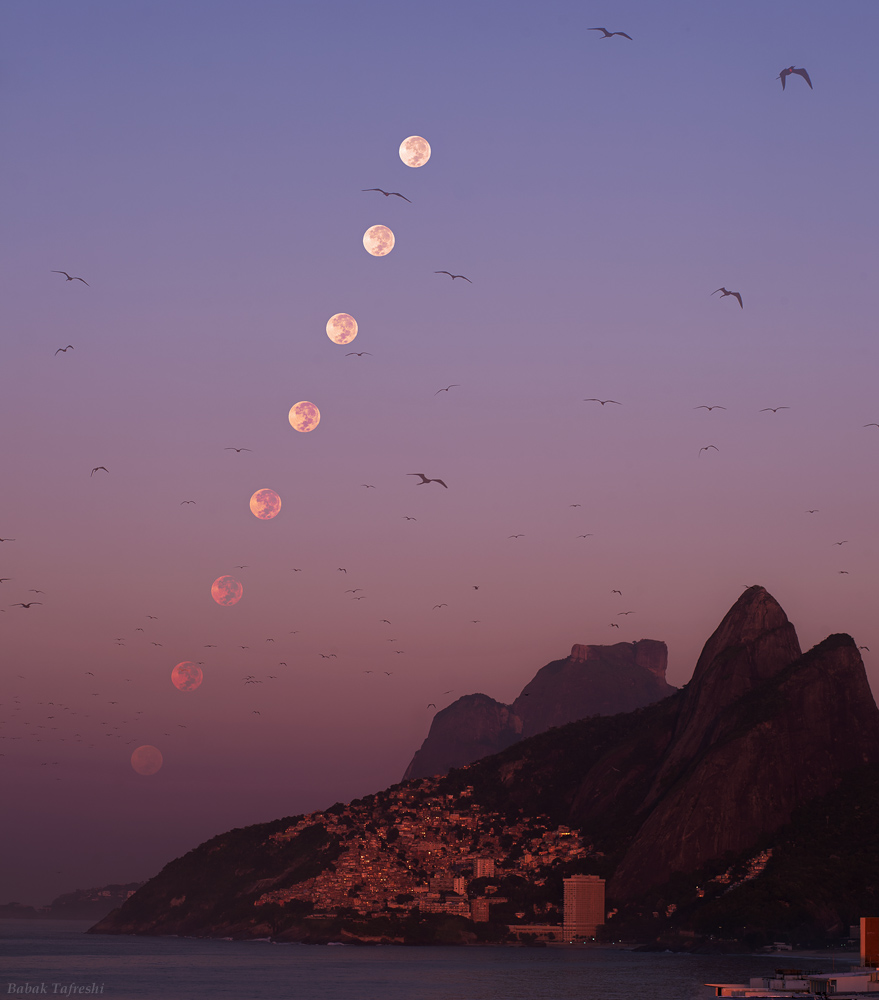
As the Sun rose, a nearly full Moon set in this serene seaside vista captured last Monday from Rio de Janeiro, Brazil. In the foreground, the reddened early morning sunlight illuminates a stretch of South Atlantic coastline. Looking toward the west, a scene that is a familiar one to Rio's Ipanema beach goers, the favela Vidigal is nestled below the twin peaks of Morro Dois Irmãos (Two Brothers Hill). This well-composed multiple-exposure image recorded the steady progress of the dramatic moonset with a 6.5 minute gap between each frame. Flying from their nests at the break of dawn, all the ocean birds appear only in the last single frame.