The Sun
The Sun is a yellow dwarf star (G2V), about 4.6 billion years old, and the dominant gravitational force in the Solar System. It has a diameter of roughly 1.4 million kilometers and contains around 99.8% of the Solar System’s mass. Nuclear fusion in its core converts hydrogen into helium, producing energy that warms the planets. Above the core lie the radiative and convective zones, followed by the visible photosphere (~5,500 °C), the chromosphere, and the much hotter corona (~2 million °C).
Source: science.nasa.gov
APODs including "The Sun"
Introducing Comet Garradd
27/07/2011
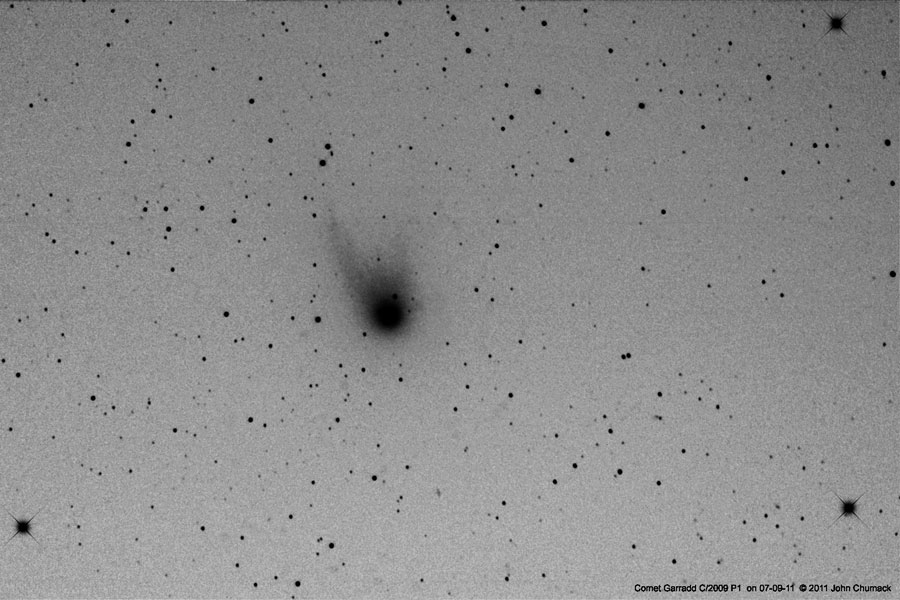
Another large snowball is falling toward the Sun. Comet Garradd was discovered two years ago by Gordon Garradd in Australia, and is currently visible through a small telescope at visual magnitude nine. Officially designated C/2009 P1 (Garradd), the comet will likely continue to brighten, with recent projections placing it at peak magnitude six or seven in February 2012, just below naked eye visibility. Comet Garradd is already showing a short tail and is seen as the elongated fuzzy patch in the above negative image recorded earlier this month from Yellow Springs, Ohio, USA. Other comets are also currently falling into the inner Solar System and brightening as well, including C/2010 X1 (Elenin), expected to peak near magnitude six in early September, 45P/Honda-Mrkos-Pajdusakova expected to peak brighten past magnitude eight in mid-August, and C/2011 L4 (PANSTARRS) which may become visible to the unaided eye during the early months of 2013.