The Sun
The Sun is a yellow dwarf star (G2V), about 4.6 billion years old, and the dominant gravitational force in the Solar System. It has a diameter of roughly 1.4 million kilometers and contains around 99.8% of the Solar System’s mass. Nuclear fusion in its core converts hydrogen into helium, producing energy that warms the planets. Above the core lie the radiative and convective zones, followed by the visible photosphere (~5,500 °C), the chromosphere, and the much hotter corona (~2 million °C).
Source: science.nasa.gov
APODs including "The Sun"
TrES-2b: Dark Planet
22/08/2011
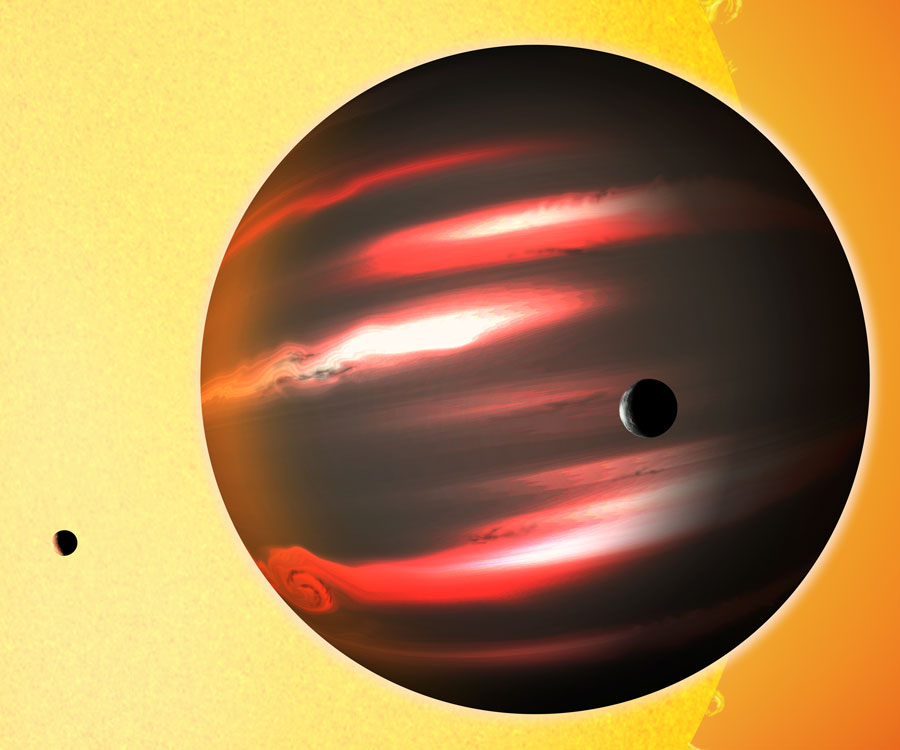
Why is this planet so dark? Planet TrES-2b reflects back less than one percent of the light it receives, making it darker than any known planet or moon, darker even than coal. Jupiter-sized TrES-2b orbits extremely close to a sun-like star 750 light years away, and was discovered producing slight eclipses in 2006 using the modest 10-cm telescopes of the Trans-Atlantic Exoplanet Survey (TrES). The alien world's strange darkness, however, was only uncovered recently by observations indicating its slight reflective glow by the Sun-orbiting Kepler satellite. An artist's drawing of planet is shown above, complete with unsubstantiated speculation on possible moons. Reasons for TrES-2b's darkness remain unknown and are an active topic of research.