The Sun
The Sun is a yellow dwarf star (G2V), about 4.6 billion years old, and the dominant gravitational force in the Solar System. It has a diameter of roughly 1.4 million kilometers and contains around 99.8% of the Solar System’s mass. Nuclear fusion in its core converts hydrogen into helium, producing energy that warms the planets. Above the core lie the radiative and convective zones, followed by the visible photosphere (~5,500 °C), the chromosphere, and the much hotter corona (~2 million °C).
Source: science.nasa.gov
APODs including "The Sun"
The Coldest Brown Dwarf
30/08/2011
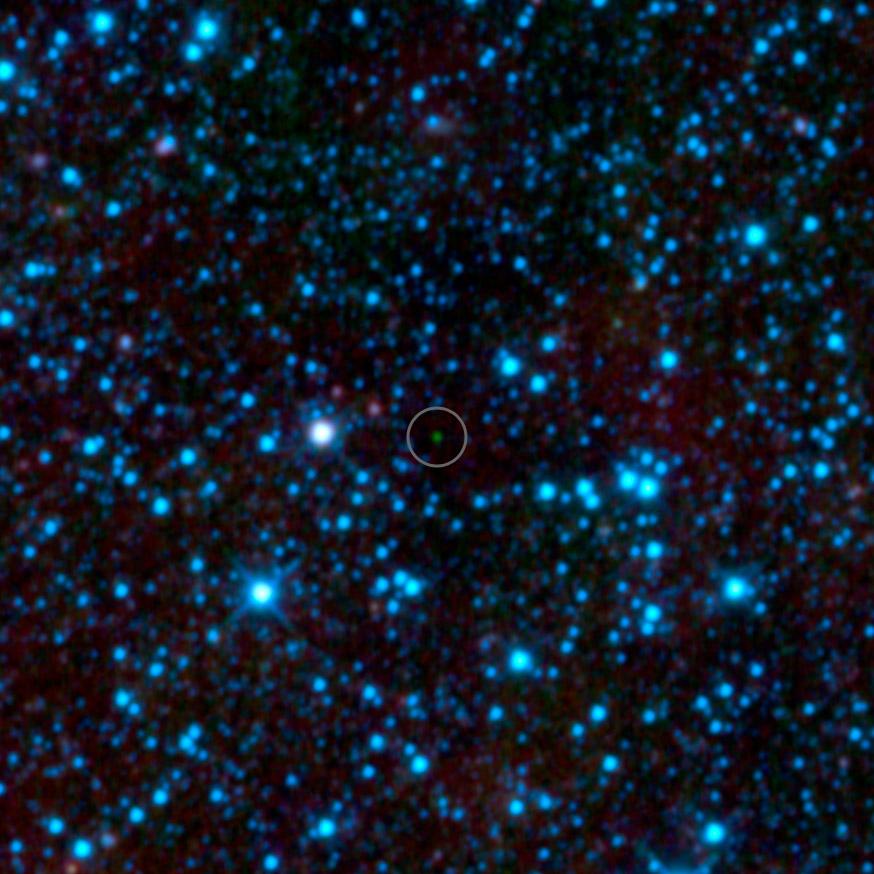
This cosmic snapshot composed with image data from NASA's Wide-field Infrared Survey Explorer (WISE) satellite captures a multitude of faint stars and distant galaxies toward the constellation Lyra at wavelengths longer than visible light. But the object circled at the center is not quite a star. Cataloged as WISE 1828+2650, it lies within 40 light-years of the Sun and is currently the coldest brown dwarf known. A brown dwarf begins like a star, with the gravitational collapse of a dense cloud of gas and dust, but is not massive enough to achieve the core temperatures and densities that trigger hydrogen fusion, the stable source of a star's energy. Instead the failed star ultimately cools and emits most of its light at infrared wavelengths. Remarkably, brown dwarfs are roughly the size of the planet Jupiter. How cold is WISE 1828+2650? While brown dwarfs have measured surface temperatures of up to 1,400 degrees C (2,600 degress F), this brown dwarf , assigned to spectral class Y, has the estimated temperature of a warm room, less than about 27 degrees C (80 degrees F).