The Sun
The Sun is a yellow dwarf star (G2V), about 4.6 billion years old, and the dominant gravitational force in the Solar System. It has a diameter of roughly 1.4 million kilometers and contains around 99.8% of the Solar System’s mass. Nuclear fusion in its core converts hydrogen into helium, producing energy that warms the planets. Above the core lie the radiative and convective zones, followed by the visible photosphere (~5,500 °C), the chromosphere, and the much hotter corona (~2 million °C).
Source: science.nasa.gov
APODs including "The Sun"
September's Aurora
23/09/2011
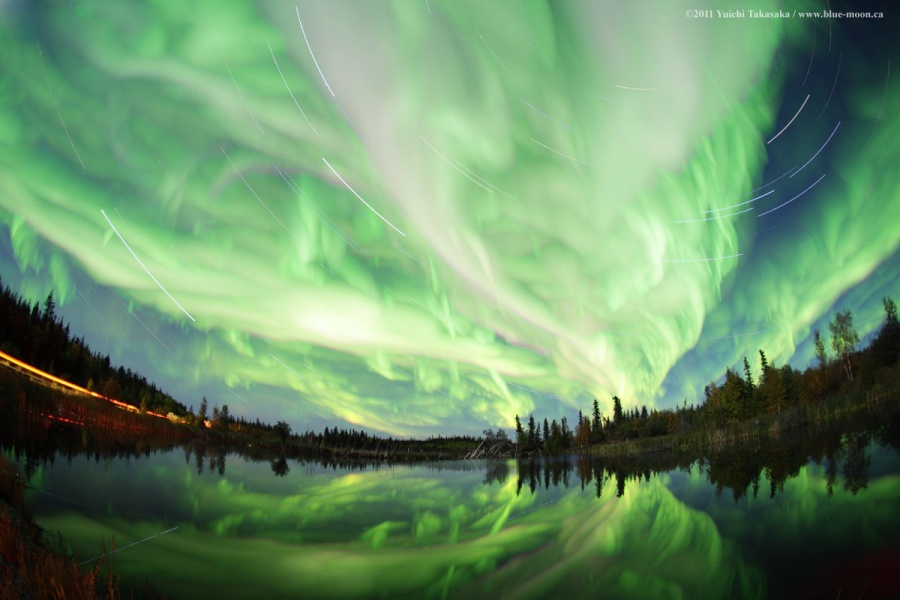
September's equinox arrives today at 0905 UT. As the Sun crosses the celestial equator heading south, spring begins in the southern hemisphere and autumn in the north. And though the seasonal connection is still puzzling, both spring and autumn bring an increase in geomagnetic storms. So as northern nights grow longer, the equinox also heralds the arrival of a good season for viewing aurora. Recorded earlier this month, these curtains of September's shimmering green light sprawl across a gorgeous night skyscape. In the foreground lies Hidden Lake Territorial Park near Yellowknife, Northwest Territories, Canada. Calm water reflects the aurora, with bright star trails peering through the mesmerizing sky glow. Of course, shining at altitudes of 100 kilometers or so, planet Earth's auroras are visible from space.