The Sun
The Sun is a yellow dwarf star (G2V), about 4.6 billion years old, and the dominant gravitational force in the Solar System. It has a diameter of roughly 1.4 million kilometers and contains around 99.8% of the Solar System’s mass. Nuclear fusion in its core converts hydrogen into helium, producing energy that warms the planets. Above the core lie the radiative and convective zones, followed by the visible photosphere (~5,500 °C), the chromosphere, and the much hotter corona (~2 million °C).
Source: science.nasa.gov
APODs including "The Sun"
Violent Sunspot Group AR 1302 Unleashes a Flare
28/09/2011
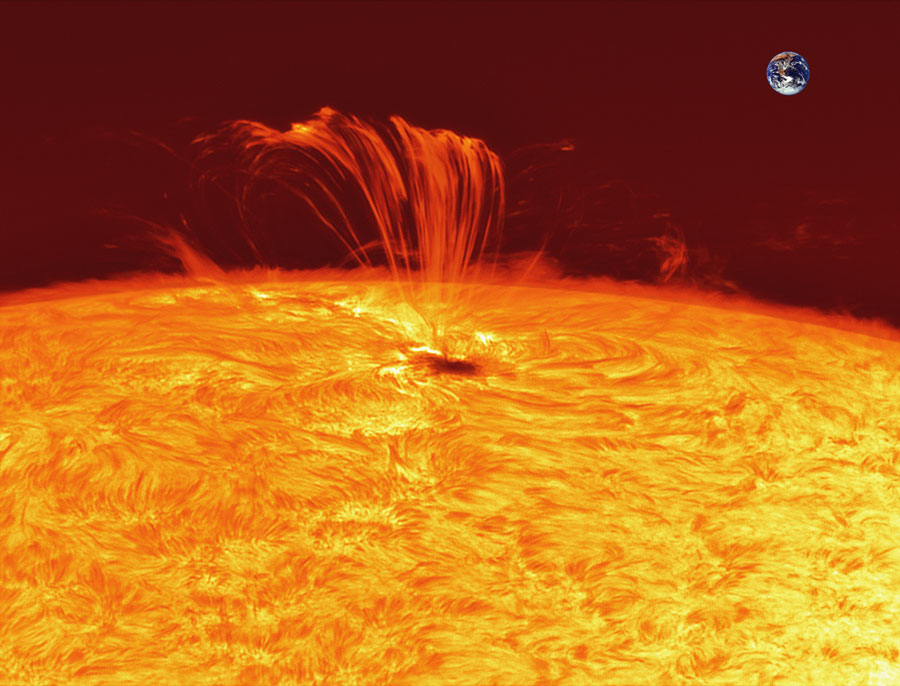
One of the most active sunspot groups in years is currently crossing the Sun. AR 1302 first came around the Sun's edge last week and is so large it can be seen without a telescope. Coronal Mass Ejections from AR 1302 have already caused strong geomagnetic storms including notable aurora activity around both of Earth's poles. Pictured above, plasma was left magnetically hanging above the Sun's surface after AR 1302 emitted an X-class solar flare last Thursday. Earth is illustrated in the inset for a size comparison. Although another X-class flare was emitted on Saturday, no flares from AR 1302 have been aimed directly at the Earth, as yet. The AR 1302 sunspot group will continue to evolve but likely remain visible on the Sun for the next week. Instant Gallery: See recent pictures of sunspot group AR 1302.