The Sun
The Sun is a yellow dwarf star (G2V), about 4.6 billion years old, and the dominant gravitational force in the Solar System. It has a diameter of roughly 1.4 million kilometers and contains around 99.8% of the Solar System’s mass. Nuclear fusion in its core converts hydrogen into helium, producing energy that warms the planets. Above the core lie the radiative and convective zones, followed by the visible photosphere (~5,500 °C), the chromosphere, and the much hotter corona (~2 million °C).
Source: science.nasa.gov
APODs including "The Sun"
Saturn: Shadows of a Seasonal Sundial
12/10/2011
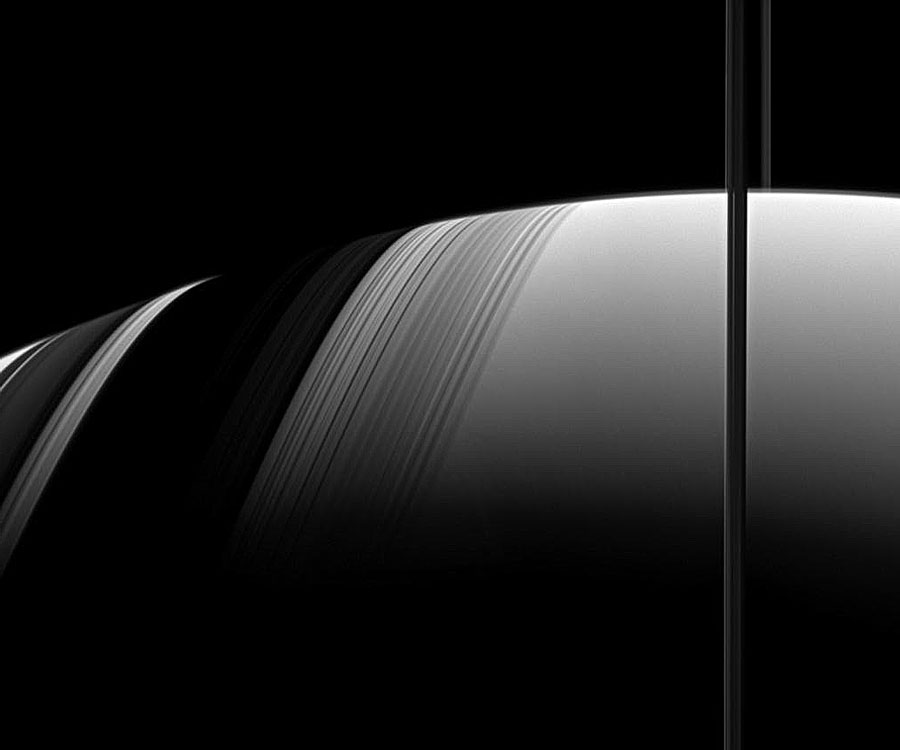
Saturn's rings form one of the larger sundials known. This sundial, however, determines only the season of Saturn, not the time of day. In 2009, during Saturn's last equinox, Saturn's thin rings threw almost no shadows onto Saturn, since the ring plane pointed directly toward the Sun. As Saturn continued in its orbit around the Sun, however, the ring shadows become increasingly wider and cast further south. These shadows are not easily visible from the Earth because from our vantage point near the Sun, the rings always block the shadows. The above image was taken in August by the robotic Cassini spacecraft currently orbiting Saturn. The rings themselves appear as a vertical bar on the image right. The Sun, far to the upper right, shines through the rings and casts captivatingly complex shadows on south Saturn, on the image left. Cassini has been exploring Saturn, its rings, and its moons since 2004, and is expected to continue until at least the maximum elongation of Saturn's shadows occurs in 2017.