The Sun
The Sun is a yellow dwarf star (G2V), about 4.6 billion years old, and the dominant gravitational force in the Solar System. It has a diameter of roughly 1.4 million kilometers and contains around 99.8% of the Solar System’s mass. Nuclear fusion in its core converts hydrogen into helium, producing energy that warms the planets. Above the core lie the radiative and convective zones, followed by the visible photosphere (~5,500 °C), the chromosphere, and the much hotter corona (~2 million °C).
Source: science.nasa.gov
APODs including "The Sun"
Tails of Comet Garradd
20/10/2011
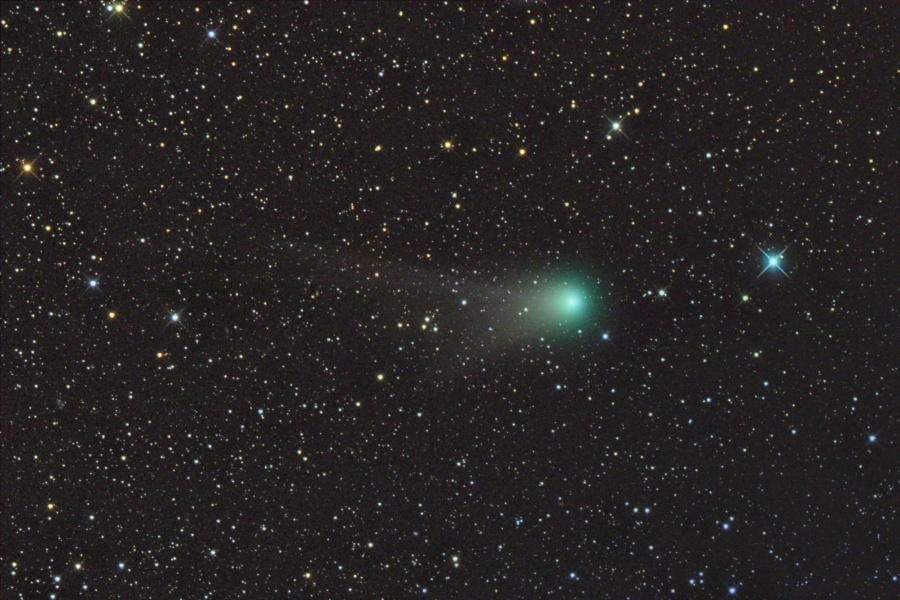
A good target for binoculars and small telescopes, Comet Garradd (C/2009 P1) now shines in planet Earth's evening skies, a steady performer but just below naked-eye visibility. Telescopic images like this composite from October 15 can find the comet with a lovely green coma, sporting multiple tails, and lingering against a background of faint stars. The field of view spans over 1 degree or about 2 full moons within the southern boundaries of the constellation Hercules. Now around 16 light minutes (2 astronomical units) away, P1 Garradd is an intrinsically large comet, but will never make a very close approach to Earth or the Sun while sweeping through the inner solar system. As a result, the comet will likely stay a sight for telescopic eyes only, moving slowly through the sky and remaining in Hercules during the coming months.