The Sun
The Sun is a yellow dwarf star (G2V), about 4.6 billion years old, and the dominant gravitational force in the Solar System. It has a diameter of roughly 1.4 million kilometers and contains around 99.8% of the Solar System’s mass. Nuclear fusion in its core converts hydrogen into helium, producing energy that warms the planets. Above the core lie the radiative and convective zones, followed by the visible photosphere (~5,500 °C), the chromosphere, and the much hotter corona (~2 million °C).
Source: science.nasa.gov
APODs including "The Sun"
Kepler 22b: An Almost Earth Orbiting an Almost Sun
07/12/2011
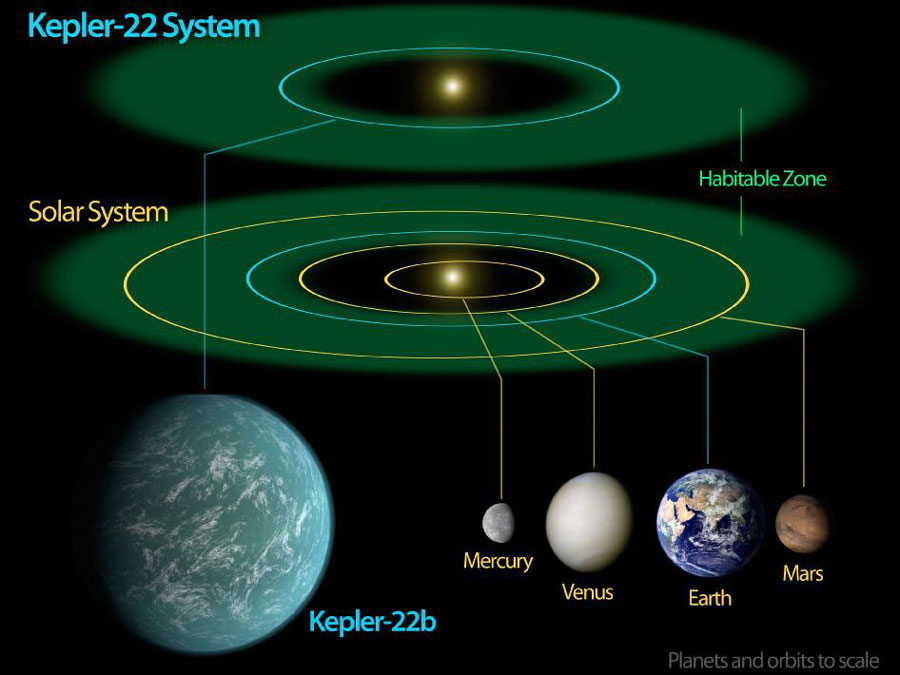
It's the closest match to Earth that has yet been found. Recently discovered planet Kepler 22b has therefore instantly become the best place to find life outside our Solar System. The planet's host star, Kepler 22, is actually slightly smaller and cooler than the Sun, and lies 600 light-years from Earth toward the constellation of the Swan (Cygnus). The planet, Kepler 22b, is over twice the radius of the Earth and orbits slightly closer in, but lies in the habitable zone where liquid water could exist on the surface. Pictured above is an artist's depiction of how Kepler 22b might appear to an approaching spaceship, in comparison to the inner planets of our Solar System. Whether Kepler 22b actually contains water or life is currently unknown. A SETI project, however, will begin monitoring Kepler 22b for signs of intelligence.