The Sun
The Sun is a yellow dwarf star (G2V), about 4.6 billion years old, and the dominant gravitational force in the Solar System. It has a diameter of roughly 1.4 million kilometers and contains around 99.8% of the Solar System’s mass. Nuclear fusion in its core converts hydrogen into helium, producing energy that warms the planets. Above the core lie the radiative and convective zones, followed by the visible photosphere (~5,500 °C), the chromosphere, and the much hotter corona (~2 million °C).
Source: science.nasa.gov
APODs including "The Sun"
Sh2-239: Celestial Impasto
08/12/2011
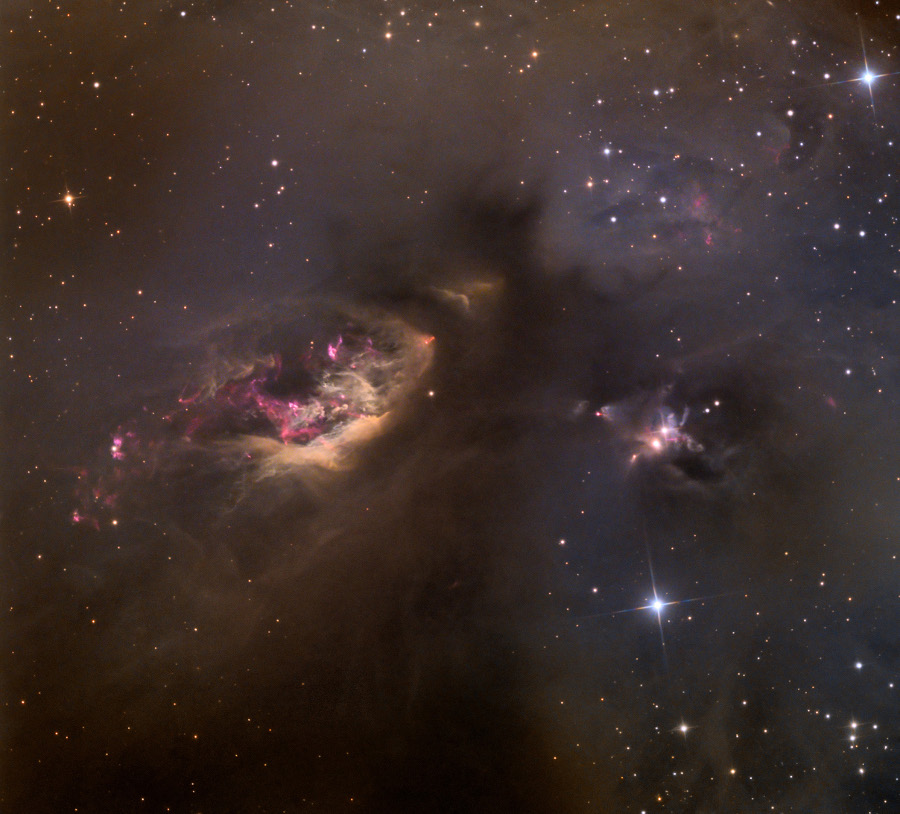
The cosmic brush of star formation composed this alluring mix of dust and dark nebulae. Cataloged as Sh2-239 and LDN 1551, the region lies near the southern end of the Taurus molecular cloud complex some 450 light-years distant. Stretching for nearly 3 light-years, the canvas abounds with signs of embedded young stellar objects driving dynamic outflows into the surrounding medium. Included near the center of the frame, a compact, tell-tale red jet of shocked hydrogen gas is near the position of infrared source IRS5, known to be a system of protostars surrounded by dust disks. Just below it are the broader, brighter wings of HH 102, one of the region's many Herbig-Haro objects, nebulosities associated with newly born stars. Estimates indicate that the star forming LDN 1551 region contains a total amount of material equivalent to about 50 times the mass of the Sun.