The Sun
The Sun is a yellow dwarf star (G2V), about 4.6 billion years old, and the dominant gravitational force in the Solar System. It has a diameter of roughly 1.4 million kilometers and contains around 99.8% of the Solar System’s mass. Nuclear fusion in its core converts hydrogen into helium, producing energy that warms the planets. Above the core lie the radiative and convective zones, followed by the visible photosphere (~5,500 °C), the chromosphere, and the much hotter corona (~2 million °C).
Source: science.nasa.gov
APODs including "The Sun"
Earthshine and Venus Over Sierra de Guadarrama
28/03/2012
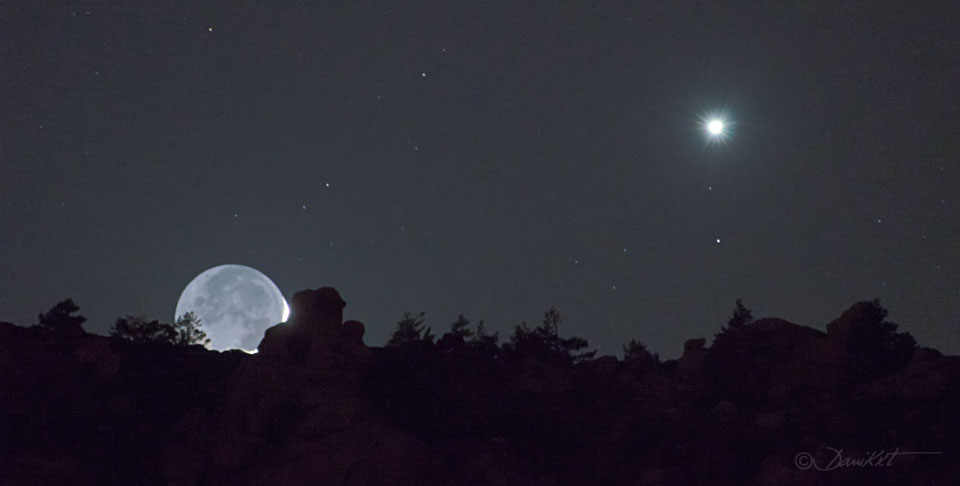
What just above that ridge? The Moon. Specifically, the Earth's Moon was caught just above the horizon in a young crescent phase. The familiar Moon might look a bit odd as the exposure shows significant Earthshine -- the illumination of the part of the Moon hidden from direct sunlight by the sun-reflecting Earth. Also captured in the image is the bright planet Venus on the right. Venus and Jupiter passed only three degrees from each other last week during a photogenic planetary conjunction. The above image was taken two days ago near Madrid, Spain. The foreground horizon silhouette includes some of the Seven Peaks of the Sierra de Guadarrama mountain range. Just a few minutes after this picture was taken, the Moon set. Conjunction Gallery: See images of the Moon, Venus, and Jupiter together over the past month.