The Sun
The Sun is a yellow dwarf star (G2V), about 4.6 billion years old, and the dominant gravitational force in the Solar System. It has a diameter of roughly 1.4 million kilometers and contains around 99.8% of the Solar System’s mass. Nuclear fusion in its core converts hydrogen into helium, producing energy that warms the planets. Above the core lie the radiative and convective zones, followed by the visible photosphere (~5,500 °C), the chromosphere, and the much hotter corona (~2 million °C).
Source: science.nasa.gov
APODs including "The Sun"
When Venus Rises with the Sun
08/06/2012
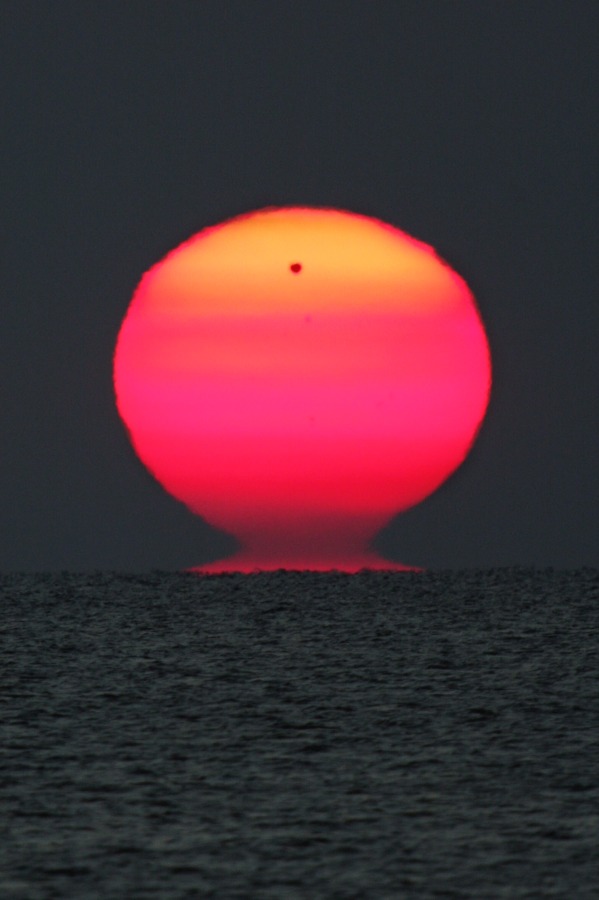
This dramatic telephoto view across the Black Sea on June 6 finds Venus rising with the Sun, the planet in silhouette against a ruddy and ragged solar disk. Of course, the reddened light is due to scattering in planet Earth's atmosphere and the rare transit of Venus didn't influence the strangely shaped and distorted Sun. In fact, seeing the Sun in the shape of an Etruscan Vase is relatively common, especially compared to Venus transits. At sunset and sunrise, the effects of atmospheric refraction enhanced by long, low, sight lines and strong atmospheric temperature gradients produce the visual distortions and mirages. That situation is often favored by a sea horizon.